
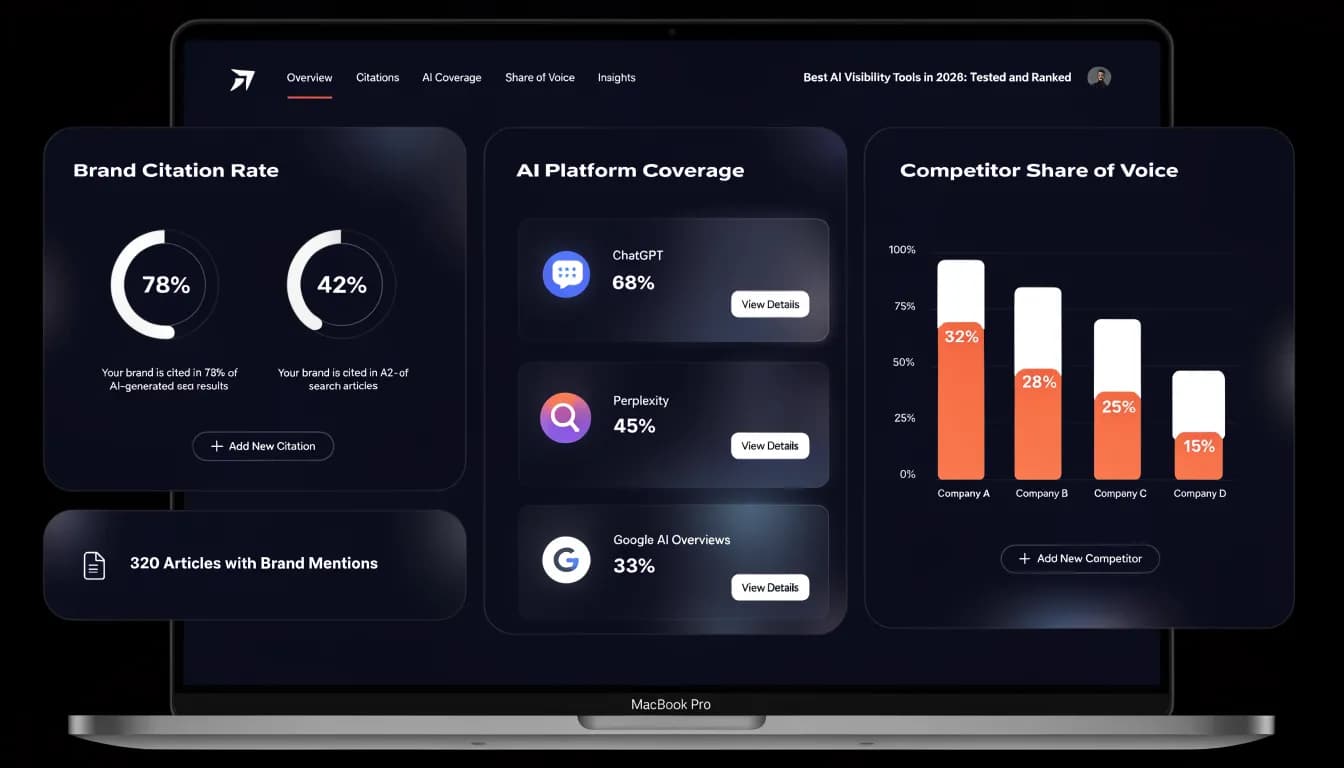
Your SEO tool shows where you rank. It doesn't show whether your brand appears in the AI answers your customers are actually reading. Which AI visibility tools are worth adding to your stack \u2014 and which ones just repackage what you already have?
Your Google rankings look fine on paper. But a growing share of your potential customers never sees your site — they get an AI-generated answer instead, pulled from somewhere else. You have no idea which sources those are, how often your brand gets mentioned (or not), or what it would take to change that. The tools you trust for SEO weren't built to answer those questions. And the gap between where your content appears in Google and where it appears in AI answers is widening every quarter.
Every week, more search queries end in a ChatGPT window, a Perplexity summary, or a Google AI Overview instead of a click. Your traffic analytics don't show you when that happens. Neither does your rank tracker. Traditional SEO tools measure your position in a results list that fewer people are scrolling through. The question isn't whether AI search is affecting your visibility — it is. The question is which tools can actually measure it, and which ones can help you do something about it.
Quick Comparison: Best AI Visibility Tools in 2026

Tool | Best For | Starting Price | AI Platforms Tracked | Free Plan |
|---|---|---|---|---|
Allable.ai | All-in-one AI marketing + visibility | Free / Pro €31/mo | ChatGPT, Perplexity, Gemini, AI Overviews | ✅ |
Enterprise brand monitoring | ~$500/mo | ChatGPT, Perplexity, Gemini, Claude | ❌ | |
Otterly.ai | Agency-scale AI SERP tracking | ~$99/mo | ChatGPT, Perplexity, Gemini | ❌ |
Peec.ai | SMB brand mention tracking | ~$79/mo | ChatGPT, Perplexity | ❌ |
Goodie.ai | GEO-focused content teams | ~$149/mo | ChatGPT, Gemini, Perplexity | ❌ |
Search Atlas | SEO teams adding AI layer | ~$99/mo | Google AI Overviews, ChatGPT | ❌ |
BrandWell | Content quality + AI brand voice | ~$39/mo | Limited | ❌ |
Semrush AI Toolkit | Existing Semrush users | ~$139/mo (Semrush Pro) | Google AI Overviews | ❌ |
Ahrefs | Backlink-focused teams tracking AI Overviews | ~$99/mo | Google AI Overviews | ❌ |
Surfer SEO | Content writers adding GEO scoring | ~$89/mo | Google AI Overviews | ❌ |
What Is AI Visibility — and Why Your SEO Metrics Are Missing It

AI visibility measures how often your brand, content, or products appear in AI-generated answers — not in a list of blue links, but in the actual response text that ChatGPT, Perplexity, Google Gemini, or AI Overviews produce when someone asks a question related to your industry.
Your current SEO tools track none of this. Rank trackers show your position in organic search results. Traffic analytics show sessions from users who clicked. Neither captures the queries that ended in an AI answer without a click, or the times a competitor got cited by ChatGPT while your site was ignored.
The scale of this blind spot is larger than most teams realize. Google AI Overviews now appear on an estimated 47% of search queries in the US. ChatGPT has over 100 million daily active users. Perplexity processes millions of queries daily with direct citations. The combined reach of AI search engines now rivals early-stage Google — and growing.
What your AI visibility score actually measures:
- Citation rate — how often your domain gets cited in AI-generated answers for relevant queries
- Brand mention frequency — how often your brand name appears in LLM responses (cited or not)
- Prompt coverage — what percentage of target queries your content shows up in
- AI share of voice — your brand mentions vs. competitors across AI platforms
None of these metrics exist in Google Search Console, Semrush, or Ahrefs out of the box. That's exactly the gap the tools on this list are built to close.
AI Visibility Tools: 10 Options Tested in 2026
The market for dedicated AI visibility tracking is less than two years old. Some tools here are purpose-built for this problem. Others are traditional SEO platforms that added an AI module. The difference in depth — and usefulness — is significant.
1. Allable.ai — Best All-in-One for AI Visibility + Full Marketing Coverage

Price: Free forever | Pro: €31/month | Business: €91/month
Allable.ai is the only platform on this list that combines AI visibility tracking with a full marketing suite — SEO, content, campaigns, social, analytics, and competitor intelligence — in a single workspace. You don't need a separate Semrush subscription for SEO and a separate Profound subscription for AI monitoring. Everything runs in the same chat-first interface.
The AI visibility module tracks your brand and content across ChatGPT, Perplexity, Google AI Overviews, and Gemini. You can run prompt coverage audits (testing which of your target queries produce AI answers that cite you), monitor competitor citation rates, and get recommendations for content changes that increase your likelihood of appearing in AI-generated results.
What makes this practically different from point solutions: when Allable identifies that a competitor is being cited more often for a keyword cluster, it connects that signal directly to your content workflow. You can brief, write, optimize, and publish content from the same platform — without exporting data between tools.
Best for: Marketing teams and SEO specialists who want AI visibility tracking without adding yet another subscription to their stack.
Pros:
- AI visibility + traditional SEO + content in one platform
- Free plan with genuine functionality (not a crippled trial)
- Direct connection between visibility data and content action
- Pro plan at €31/mo is the most cost-efficient full-stack option on this list
Cons:
- Newer platform — less historical data than Semrush or Ahrefs
- Some advanced enterprise reporting features still in development
2. Profound — Best for Enterprise Brand Monitoring Across AI Platforms

Price: Custom pricing, starting ~$500/month
Profound is the most comprehensive enterprise-grade AI visibility platform currently available. It monitors your brand mentions and citations in real time across ChatGPT, Perplexity, Gemini, and Claude — across thousands of prompts per day, not a handful of manual tests.
For large brands running awareness campaigns, Profound provides the kind of reporting depth that justifies the price: share-of-voice tracking across AI platforms, competitor citation benchmarking, and historical trend data that shows how your AI visibility changes over a campaign period.
The dashboard is genuinely useful — not just raw citation counts, but context (what the AI said about you, whether the mention was positive, which prompts triggered it). That qualitative layer is something cheaper tools don't offer.
Best for: Enterprise marketing teams with dedicated budget for AI monitoring and a genuine need for real-time, high-volume tracking.
Pros:
- Real-time monitoring at scale (thousands of prompts tracked daily)
- Multi-platform coverage including Claude and Gemini
- Qualitative context on brand mentions, not just frequency counts
- Strong competitor benchmarking
Cons:
- Pricing puts it out of reach for most SMBs and mid-market teams
- No content optimization recommendations — monitoring only
- Setup requires a significant onboarding investment
3. Otterly.ai — Best for Agency-Scale AI SERP Tracking

Price: From ~$99/month
Otterly.ai positions itself as the rank tracker for AI search. You define a set of prompts, it runs them across ChatGPT, Perplexity, and Gemini on a schedule, and tracks how often your (or your client's) brand appears in the answers.
For agencies, the multi-client workspace is the main draw. You can manage multiple brands in separate workspaces, run weekly prompt audits, and generate white-label reports for clients who want to understand their AI search presence. The interface is clean and the prompt testing workflow is fast.
The limitation is that Otterly is a monitoring tool, not an optimization tool. It tells you where you stand in AI search — it doesn't tell you what to do about gaps.
Best for: Agencies tracking AI visibility for multiple clients, or internal teams running ongoing prompt audits.
Pros:
- Clean multi-client interface built for agency workflows
- Scheduled prompt tracking across three major AI platforms
- White-label reporting for client presentations
- Competitive pricing relative to enterprise alternatives
Cons:
- No content optimization recommendations
- No integration with content workflows or SEO tools
- Coverage limited to ChatGPT, Perplexity, and Gemini (no Claude)
4. Peec.ai — Best for SMBs Tracking Brand Mentions in LLMs

Price: From ~$79/month
Peec.ai is a lightweight European startup focused on one thing: tracking how often your brand appears in LLM responses. The setup is fast — you add your brand name, a few competitors, and a set of prompts. Peec runs those prompts across ChatGPT and Perplexity and returns a visibility score with competitive context.
For teams new to AI visibility tracking, Peec is a sensible starting point. The barrier to entry is low, the interface requires no training, and the weekly reports give you enough data to understand whether your AI presence is growing or shrinking.
The ceiling is also low. Peec doesn't connect visibility data to content recommendations, doesn't cover the full range of AI platforms, and doesn't scale well beyond 20–30 tracked prompts before pricing becomes limiting.
Best for: SMBs and solo marketers who want a simple, affordable first step into AI visibility tracking.
Pros:
- Fast setup, minimal learning curve
- Weekly automated reports with competitive comparison
- Fair pricing for small-team use
- Good for establishing a baseline before investing in deeper tools
Cons:
- Limited to ChatGPT and Perplexity (no Gemini, no Claude)
- No content optimization or workflow integration
- Prompt volume limits constrain usefulness as you scale
5. Goodie.ai — Best for Content Teams Focused on GEO

Price: From ~$149/month
Goodie.ai is built specifically for generative engine optimization — structuring and formatting your content so AI engines prefer to cite it. Where most tools on this list measure AI visibility, Goodie focuses on improving it through content-level changes.
The platform analyzes your existing pages and gives specific recommendations: add a direct answer in the first 100 words, restructure this section as a list, improve factual density in this paragraph. The recommendations are grounded in what the major AI engines prefer when selecting citations.
This is the right tool if your main problem is that you know you're not being cited in AI results and you want a systematic way to fix that — not just track it.
Best for: Content teams who've already identified AI visibility gaps and want structured optimization guidance.
Pros:
- Actionable, content-level recommendations (not just metrics)
- GEO optimization framework grounded in how AI engines select citations
- Covers ChatGPT, Gemini, and Perplexity citation patterns
- Clear before/after scoring makes progress measurable
Cons:
- More expensive than monitoring-only alternatives
- Requires content team bandwidth to implement recommendations
- No traditional SEO features — GEO only
6. Search Atlas — Best for SEO Teams Adding an AI Visibility Layer

Price: From ~$99/month
Search Atlas started as a traditional SEO platform and has built a GEO module directly into its interface. If you're already using it for keyword research, site audits, and rank tracking, the AI visibility features are a natural extension — you don't need to add a separate tool.
The AI content scoring module evaluates your pages for GEO readiness: factual accuracy signals, citation structure, topical authority, and semantic depth. It also tracks Google AI Overview appearances as part of the standard rank-tracking dashboard.
The GEO features are solid but not as deep as Goodie.ai's dedicated optimization engine. Where Search Atlas wins is the integration: your AI visibility data lives in the same place as your keyword and ranking data.
Best for: Teams already using Search Atlas for SEO who want AI visibility tracking without switching platforms.
Pros:
- GEO module integrated with existing SEO workflows
- Google AI Overviews tracking in standard rank tracking dashboard
- AI content scoring with actionable recommendations
- Competitive pricing for the breadth of features
Cons:
- GEO features less deep than dedicated AI visibility tools
- Less coverage of non-Google AI platforms (Perplexity, Claude)
- Brand new features — less battle-tested than core SEO functionality
7. BrandWell — Best for Content Quality and AI Brand Voice Consistency

Price: From ~$39/month
BrandWell is primarily a content quality and brand voice platform. Its AI visibility features are secondary — it tracks some brand mention signals, but the main value proposition is helping you produce content that AI engines treat as authoritative. The focus is on E-E-A-T signals, factual density, and brand voice consistency across your content portfolio.
If your AI visibility problem is fundamentally a content quality problem (thin pages, inconsistent brand positioning, low factual depth), BrandWell addresses the root cause. If you need systematic prompt tracking or competitive monitoring, it's not the right tool.
Best for: Content teams focused on improving the quality signals that affect AI citation likelihood, rather than tracking citation rates.
Pros:
- Very affordable entry price
- Strong E-E-A-T and content quality analysis
- Brand voice consistency checking across content portfolio
- Good for teams building from a content quality baseline
Cons:
- Limited AI platform monitoring vs. dedicated visibility tools
- Not a true AI visibility tracker — more of an indirect optimization tool
- Reporting is content-focused, not visibility-metrics-focused
8. Semrush AI Toolkit — Best for Existing Semrush Users Tracking AI Overviews

Price: Included with Semrush Pro (~$139/month) or as add-on
Semrush has built AI visibility features directly into its platform — primarily focused on Google AI Overviews. The AI Overview tracking module shows you which of your tracked keywords trigger AI Overviews, whether you appear in them, and how that's affecting your click-through rates.
For teams already paying for Semrush, this is a zero-friction way to start tracking AI visibility for Google search specifically. The integration with keyword research, competitive analysis, and content tools makes it genuinely useful — if Google AI Overviews are your primary concern.
The limitation is scope: Semrush's AI features are almost entirely Google-centric. ChatGPT, Perplexity, and Gemini visibility are not meaningfully tracked. If you care about the broader AI search landscape, you'll need a separate tool.
Best for: Teams already on Semrush who want AI Overview tracking without adding another subscription.
Pros:
- Integrates directly with existing Semrush workflows — no new tools to learn
- Strong Google AI Overviews coverage and CTR impact analysis
- No additional cost if you're already on Semrush Pro
- Good keyword-level breakdown of AI Overview appearances
Cons:
- Almost exclusively Google-focused — no meaningful Perplexity or ChatGPT tracking
- Semrush's base price ($139/mo) makes this expensive if AI visibility is your only need
- Less depth than dedicated AI visibility platforms
9. Ahrefs — Best for Backlink-Focused SEO Teams Adding AI Overview Tracking

Price: From ~$99/month
Ahrefs recently added AI Overview tracking to its rank tracker. Like Semrush's implementation, the focus is on Google — specifically, which keywords trigger AI Overviews and whether your pages appear in them. The data integrates cleanly with Ahrefs' existing organic search metrics.
If Ahrefs is your primary SEO tool and Google AI Overviews are your main AI search concern, this is a solid, low-friction upgrade. The rank tracking interface is clean, the AI Overview data updates regularly, and you don't need to learn a new tool.
Beyond Google AI Overviews, Ahrefs has limited AI search coverage. It's not designed for prompt-based monitoring or cross-platform AI visibility tracking.
Best for: Teams already on Ahrefs who want Google AI Overview visibility without switching or adding tools.
Pros:
- Clean integration with Ahrefs' existing rank tracking
- Reliable Google AI Overview data alongside organic rankings
- Good historical trend tracking for AI Overview appearances
- No additional cost over standard Ahrefs subscription
Cons:
- Google-only AI visibility — no ChatGPT, Perplexity, or Gemini monitoring
- No content optimization recommendations for AI search
- AI features are a complement to SEO, not a standalone visibility solution
10. Surfer SEO — Best for Content Writers Adding GEO Scoring to Their Workflow

Price: From ~$89/month
Surfer SEO added generative engine optimization (GEO) scoring to its content editor. As you write or edit a page, Surfer now shows you a GEO score alongside its traditional SEO score — evaluating how well your content is structured for AI citation selection.
The GEO scoring is built into Surfer's existing content editor workflow, which means content writers can optimize for both traditional SEO and AI visibility in the same interface without switching tools. The recommendations focus on answer clarity, factual density, and citation-friendly formatting.
Surfer's GEO features are early-stage compared to dedicated tools like Goodie.ai, but the price-to-value ratio is strong if you're already a Surfer user. If you're not, the GEO module alone doesn't justify the subscription.
Best for: Content writers already using Surfer SEO who want GEO guidance without adding a separate tool.
Pros:
- GEO scoring integrated into familiar content editor workflow
- Real-time feedback as you write or optimize existing pages
- Strong price-to-value if you're an existing Surfer user
- Good for teams building GEO discipline into their content process
Cons:
- GEO features less mature than dedicated GEO tools
- No standalone AI visibility monitoring (citation tracking, prompt coverage)
- Optimizes for Google-centric AI signals — limited cross-platform coverage
AI Search Visibility: The Metrics That Actually Matter
Tracking AI search visibility requires a different measurement framework than traditional SEO. Here's what the metrics actually mean and why they matter:
Citation rate is the percentage of AI responses (for your target prompts) that include a link to or reference of your domain. A citation rate of 20% means 1 in 5 relevant AI queries returns an answer that cites you. Improving this is the core goal of GEO.
Brand mention rate tracks how often your brand name appears in AI responses — including responses that don't include a direct link. Brand mentions without citations still influence AI model training and user perception, especially as LLMs are updated with newer data.
Prompt coverage shows which of your target queries already produce AI answers that cite you, which produce answers that cite competitors, and which produce answers where no one in your industry gets mentioned. The third category is your fastest opportunity — you're not competing with strong citations, you're filling a gap.
AI share of voice is your brand mention count divided by the total mentions for your category across a defined prompt set. This is the competitive metric — it tells you whether you're gaining or losing ground relative to specific competitors.
Most tools on this list measure some combination of these four metrics. The difference between them is coverage (which AI platforms), depth (how many prompts, how frequently), and actionability (do they connect data to content recommendations).
Generative Engine Optimization: What It Actually Requires
Generative engine optimization (GEO) is the practice of structuring and optimizing your content so that large language models prefer to cite it when generating answers.
The mechanics differ from traditional SEO in specific ways:
Direct answers beat optimized introductions. AI engines scan for content that directly answers the query, not content that builds toward an answer over 800 words. If your target query is "what is [X]", your page needs a direct, one-to-two sentence definition in the first 100 words — not after three paragraphs of context.
Factual density matters more than keyword density. LLMs prefer content with verifiable facts, statistics, and specific claims over content that uses keywords frequently but makes vague assertions. A page with 12 specific data points outperforms a page with 12 keyword mentions.
Citation-friendly structure increases selection probability. Lists, tables, and clearly delimited sections (with strong H2/H3 structure) are easier for AI engines to extract and cite. Content that reads as one continuous paragraph is harder to parse into a clean citation.
Entity clarity helps models identify your brand. Consistent use of your exact brand name, product names, and category terms across your content helps LLMs accurately identify and attribute your content. Inconsistent naming reduces the probability that a mention is correctly attributed to you.
These principles apply across ChatGPT, Perplexity, Google AI Overviews, and Gemini — the specifics vary, but the underlying logic is the same: AI engines favor content that is accurate, structured, and directly responsive.
How to Improve AI Visibility Without Rebuilding Your Stack
You don't need to replace your current tools to start improving your AI visibility. Here's a practical sequence for teams starting from zero:
Step 1: Establish a baseline (Week 1) Pick your 20–30 most important queries and run them manually through ChatGPT, Perplexity, and Google AI Overviews. Note which ones produce AI answers, which competitors get cited, and whether your brand appears. This takes two hours and gives you a baseline without any tool subscription.
Step 2: Add a monitoring tool (Month 1) Once you have a baseline, add one monitoring tool to automate what you just did manually. If budget is tight, Peec.ai or Allable.ai's free plan are the lowest-friction starting points. If you're an agency with multiple clients, Otterly.ai's structured workflow justifies the cost.
Step 3: Identify your highest-opportunity content gaps (Month 1–2) Look for query categories where AI answers consistently cite competitors but not you — especially where those competitors don't have dramatically stronger content. These are your fastest wins. Your existing content may already be close to citation-worthy; it may need structural changes more than full rewrites.
Step 4: Apply GEO principles to your top 10 pages (Month 2–3) Take the pages targeting your highest-volume queries and apply the GEO fundamentals: direct answers in the first 100 words, verifiable data points, clean section structure. Measure citation rate changes over 4–6 weeks. Most teams see measurable improvement within one update cycle.
Step 5: Build AI visibility into your content workflow (Ongoing) The teams that compound their AI visibility advantage are the ones that build GEO review into their standard content process — not as a separate audit, but as a final check before every publish. One platform that handles both your SEO and GEO review reduces the friction here significantly.
Frequently Asked Questions
What is AI visibility?
AI visibility is how often your brand, content, or products appear in AI-generated answers — in ChatGPT, Perplexity, Google AI Overviews, and Gemini — when users ask questions relevant to your industry. Unlike traditional search visibility (which measures your ranking position in a list of blue links), AI visibility measures citation rate and brand mention frequency in the actual text of AI responses.
What are the best AI SEO tools for teams on a budget?
For teams with limited budgets, Allable.ai offers the broadest functionality at the lowest cost — the free plan covers AI visibility tracking alongside SEO, content, and competitor tools. Peec.ai (~$79/mo) is the lightest-weight dedicated monitoring option. If you're already paying for Semrush or Ahrefs, their built-in AI features (focused on Google AI Overviews) add zero incremental cost.
How do AI visibility tools differ from traditional SEO tools?
Traditional SEO tools measure where your pages rank in Google's organic results list. AI visibility tools measure whether your content gets cited in AI-generated answers — a fundamentally different signal. A page ranked #8 in Google might get cited frequently in ChatGPT responses; a page ranked #1 might never appear in an AI answer. The two signals are correlated but not equivalent, and optimizing for one doesn't automatically optimize for the other.
Is generative engine optimization different from traditional SEO?
Yes — in important ways. GEO prioritizes direct answer structures, factual density, and citation-friendly formatting over keyword density and backlink volume. That said, traditional SEO signals (domain authority, topical depth, content quality) still influence which sources AI engines favor when selecting citations. GEO isn't a replacement for SEO — it's an additional layer that addresses a growing share of search behavior that traditional SEO tools don't capture.
The Bottom Line
The right AI visibility tool depends on what you're actually trying to solve:
- You want the most affordable all-in-one option → Allable.ai (Free–€31/mo)
- You need enterprise-scale real-time monitoring → Profound (~$500+/mo)
- You're an agency managing multiple client brands → Otterly.ai (~$99/mo)
- You want a lightweight first step → Peec.ai (~$79/mo)
- Your focus is content-level GEO optimization → Goodie.ai (~$149/mo)
- You're already on Semrush → use their AI Toolkit (included)
- You're already on Ahrefs → enable AI Overviews tracking (included)
- You're already on Surfer SEO → use the GEO scoring module (included)
One thing is clear: ignoring AI search visibility entirely is no longer a defensible strategy. The platforms where your potential customers are getting answers are changing faster than most SEO playbooks acknowledge. The tools to track and improve your position in those platforms exist now, at every price point. The teams building that infrastructure today will have a meaningful data advantage over those starting in 12 months.
Your competitors are already in this. The question is where you are.