Claude Pricing: What It Actually Costs in 2026 (And Whether It's Worth It)
 Written by Martin J.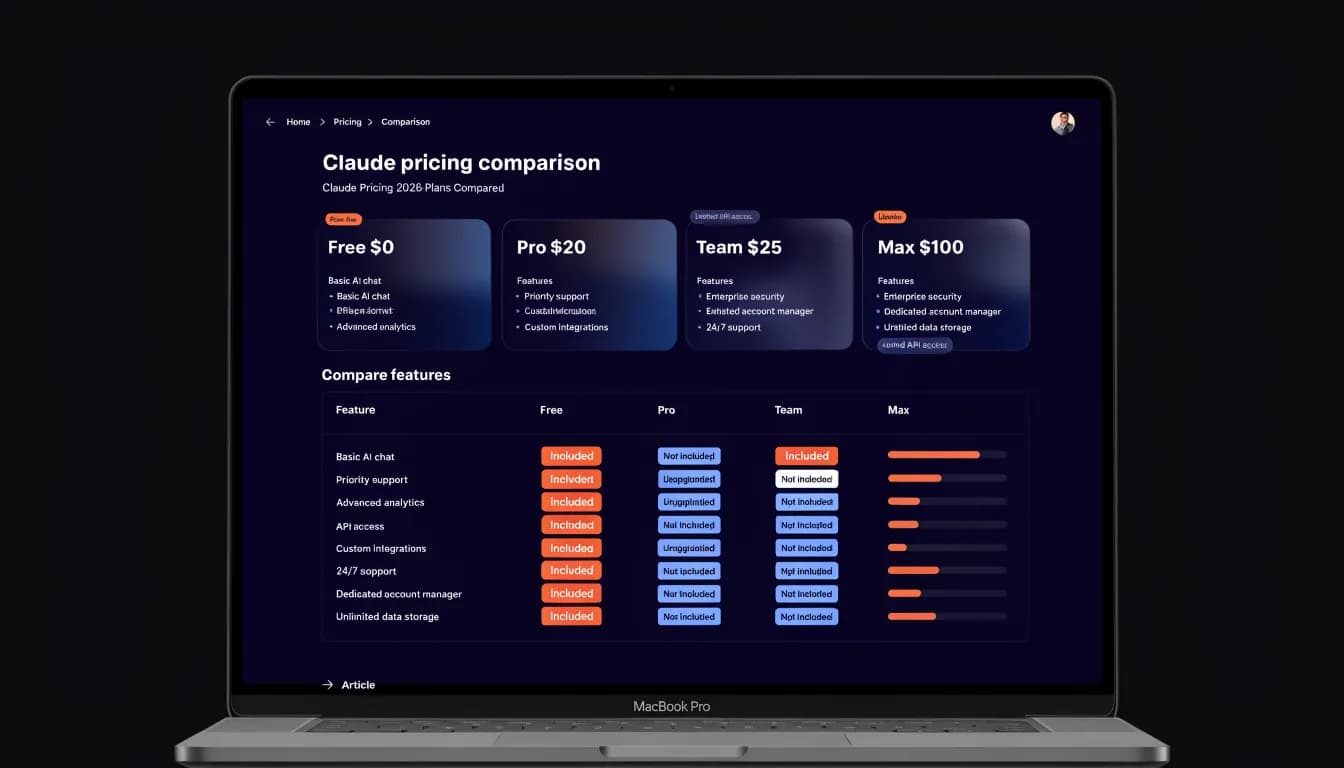
Anthropic built Claude to be useful for serious work. The pricing structure it ships with — five tiers, a separate API model, and rate limits the company politely declines to publish — is less straightforward. Most people paying for Claude Pro use maybe 30% of what the plan includes. Have you ever mapped your actual Claude usage against what your current plan provides — or just picked the tier that felt right and moved on? For most teams, the answer explains a lot about why the AI line item keeps climbing.
Your workflow doesn't fail because Claude isn't capable enough. It fails because you're on the wrong plan for the way you actually work — or on the right plan for an imaginary version of your workflow that doesn't exist yet. Claude has four consumer-facing pricing tiers, a developer Max plan, and a token-based API structure that prices differently depending on which model you're calling. If you're making decisions based on the $20/month number alone, you're making a decision with incomplete information. Here's what Claude actually costs — and what you actually get.
Claude Pricing 2026: All Plans at a Glance

Plan | Price | Best For | Context Window |
|---|---|---|---|
Claude Free | $0/month | Personal testing, occasional use | 200K tokens |
Claude Pro | $20/month | Power users, daily professional use | 200K tokens |
Claude Team | $25/user/month (5-seat min) | Teams with shared workflows | 200K tokens |
Claude Max | $100/month or $200/month | API-heavy and agentic workflows | Extended |
Claude Enterprise | Custom pricing | Organizations with compliance requirements | 200K tokens+ |
All plans share the same 200,000-token context window — that's roughly 150,000 words. The differences are in rate limits, model access, admin controls, and what Anthropic does with your data.
Claude Free Plan: What You Actually Get (And Where It Stops)
The Free plan gives you access to Claude's models at no cost. What it doesn't give you is reliable daily capacity.
Anthropic doesn't publish exact Free-tier rate limits, but in practice: most users report being able to send 10–20 substantial messages before hitting a daily message cap. That's enough to test Claude's capabilities, run occasional one-off tasks, or explore whether the tool fits your workflow. It is not enough for professional content production, marketing workflows, or any use case that requires consistent output volume.
What Free actually includes:
- Access to Claude's core models (typically Haiku 3.5 and limited Sonnet access)
- 200K token context window (technically — though you'll hit message limits before context limits matter)
- Conversation history within sessions
What Free excludes:
- Priority access during peak hours (your requests go behind paying users)
- Access to the most capable models (Opus 4, Sonnet 3.7)
- Projects feature for organizing persistent context
- Higher API rate limits
If you're evaluating Claude for a professional workflow, Free gives you enough to make an informed decision. As a permanent tool for any kind of consistent output, it doesn't hold up. Most marketing teams burn through the daily Free limit within the first hour of a working session.
Claude Pro Pricing: Is $20/Month Worth It?
At $20/month, Claude Pro is priced identically to ChatGPT Plus and near-identically to Gemini Advanced ($19.99/month). The price is a wash across the board. The value depends on what you actually do with it.
What Claude Pro includes:
- 5x the usage limits of the Free plan
- Access to Claude Opus 4 and Claude Sonnet 3.7 (the most capable models)
- Priority access during peak hours
- Projects feature — persistent memory and context across conversations
- 200,000-token context window with the ability to actually use it
The 200K context window is where Claude Pro earns its keep for content teams. If you're working with long-form research, brand guidelines, or feeding in competitor articles for analysis, Claude's context capacity is larger than what you get with ChatGPT Plus by default. Extended context means you can give Claude an entire 10,000-word strategy document and get analysis that actually incorporates all of it.
The rate limit reality: Pro's 5x multiplier over Free is real — but heavy users still hit throttling during peak hours, typically mid-afternoon US Eastern time. Anthropic doesn't publish hard caps, so you won't know you're about to hit a limit until you do. Plan around that.
Pro is worth $20/month if:
- You're a solopreneur or individual contributor using Claude daily
- You need access to Opus 4 or Sonnet 3.7 for complex reasoning or long-form writing
- The extended context window aligns with your actual workflow (long documents, research synthesis)
Pro is probably not the right choice if:
- Multiple people on your team need Claude access — Pro ties to a single account
- You're running consistent high-volume output and hitting limits mid-workflow
- You need admin controls, usage analytics, or centralized billing
Claude Team ($25/user/month): When Teams Actually Need It
The Team plan costs $25/user/month with a minimum of 5 seats — meaning your floor is $125/month before anyone has opened a conversation. That's the first number to stress-test before upgrading.
What Team adds over Pro:
- Higher per-user usage limits (meaningfully more than Pro, not just 5x over Free)
- Centralized billing and admin console
- Usage analytics across the team
- Conversations are not used to train Anthropic's models — this is a policy difference from Free and Pro
- Dedicated capacity that's less susceptible to peak-hour throttling
That data training policy difference matters for professional use. On Free and Pro, your conversations may be used by Anthropic to improve its models by default. If you're feeding Claude client briefs, proprietary strategy documents, or competitive research — and you're on the Free or Pro plan — that's worth knowing.
Team makes sense when:
- Three or more people are regularly hitting Pro rate limits individually
- You need centralized billing instead of individual subscriptions
- Data privacy relative to model training is a professional requirement
- You need usage analytics to understand AI adoption across your team
Team probably doesn't make sense when:
- You have fewer than 3–4 active Claude users (individual Pro subscriptions cost less)
- Your team's Claude usage is light and irregular
Claude API Pricing: What You Actually Pay Per Request

If you're using Claude through third-party tools or building it into your own workflows, you're working with the API — and the pricing is per token, not per month.
Anthropic charges separately for input (what you send Claude) and output (what Claude generates):
Model | Input (per million tokens) | Output (per million tokens) | Best For |
|---|---|---|---|
Claude Haiku 3.5 | $0.80 | $4.00 | High-volume, speed-sensitive tasks |
Claude Sonnet 4 | $3.00 | $15.00 | Balanced quality and cost |
Claude Opus 4 | $15.00 | $75.00 | Complex reasoning, nuanced analysis |
What does this actually cost in practice?
A million tokens is roughly 750,000 words — so per-token costs look microscopic until you're running volume. Here's what real marketing tasks cost:
- 1,000-word blog post (800-word input context + 1,000-word output): roughly $0.004 on Haiku, $0.02 on Sonnet, $0.09 on Opus 4
- 100 content briefs/month at the above rate: $0.40 on Haiku, $2.00 on Sonnet, $9.00 on Opus 4
- High-volume classification or tagging (1M tokens input, minimal output): $0.80 on Haiku vs. $15.00 on Opus 4 — model selection has 18x cost impact at scale
The practical decision rule: Start with Haiku for anything that requires speed and volume — categorization, summarization, structured extraction. Move to Sonnet for content that needs to be good: long-form writing, strategy synthesis, research analysis. Reserve Opus 4 for tasks where the output quality has direct business impact and volume is low.
Anthropic also offers a 50% discount via its Message Batches API for workloads that don't require real-time responses. For agencies or teams doing bulk content generation, that discount compounds quickly.
Claude Code Pricing: The Max Plan for Agentic Workflows
Claude Code is Anthropic's agentic coding product — it operates autonomously in your codebase, writes and runs code, debugs, and executes multi-step tasks. It's designed for developers, but it's relevant context for marketers exploring what the tool industry calls "vibe coding" or agentic marketing AI.
The Claude Code Max plans are priced separately from standard Claude subscriptions:
Plan | Price | What It Provides |
|---|---|---|
Claude Max (5x) | $100/month | 5x higher API usage limits for agentic tasks |
Claude Max (20x) | $200/month | 20x higher API usage limits, extended capacity |
These plans are for heavy API users running autonomous agents — not for marketers using Claude.ai through a browser. If you're evaluating whether to use Claude Code to automate content workflows, templated campaign builds, or landing page generation, the $100–$200/month range reflects what serious agentic usage actually costs at scale.
For most marketing teams, Claude Code Max is not the right starting point. Understanding it exists helps you contextualize the pricing structure — and helps you avoid paying Max rates when standard Pro or Team would cover your actual use case.
Claude vs. ChatGPT Pricing: Side-by-Side
At the subscription level, the pricing is nearly identical:
Plan | Claude | ChatGPT |
|---|---|---|
Individual (Pro/Plus) | $20/month | $20/month |
Team | $25/user/month (5-seat min) | $30/user/month |
Enterprise | Custom | Custom |
The price doesn't differentiate the choice. What does:
Claude's advantages:
- Longer context window (200K tokens vs. ChatGPT's 128K default)
- Stronger performance on nuanced long-form writing and document analysis
- More direct, less hedging output style
ChatGPT's advantages:
- Native web browsing and real-time search
- DALL-E image generation included at the Plus tier
- Larger plugin and integration ecosystem
- o1 and o3 reasoning models available
At the API level: Claude Sonnet 4 ($3.00/M input) and GPT-4o ($2.50/M input) are priced within 20% of each other. For high-volume API use, model performance and rate limit stability matter more than the per-token price difference. You can read a detailed breakdown in our Claude vs ChatGPT comparison.
The Team plan pricing is worth noting: Claude Team is $25/user/month vs. ChatGPT Team at $30/user/month. At 10 users, that's a $600/year difference — real money, though not the primary decision factor.
The Verdict: Which Claude Plan Fits Your Situation
Free — Use it to evaluate Claude before paying. Not reliable for professional daily use.
Pro ($20/month) — Right for individual contributors using Claude intensively. Strong context window, access to best models, manageable rate limits for individual workflows.
Team ($25/user/month, 5-seat minimum) — Right for three or more active users who need consistent throughput and centralized control. The data training opt-out also matters for professional use cases involving proprietary content.
Max ($100–$200/month) — Right for developers and teams running autonomous Claude agents at scale. Not the right plan for standard marketing workflows.
API (pay-per-use) — Right for teams building Claude into custom workflows or platforms. Start with Haiku for volume tasks, Sonnet for content quality, Opus 4 only when output quality has direct revenue impact.
Enterprise (custom) — Right for regulated industries or organizations with security and compliance requirements that Free and Team plans don't satisfy.
Claude is a genuinely capable model — particularly on long documents, nuanced reasoning, and structured analysis. The pricing structure is reasonable for what you get. The decision isn't really whether Claude is worth paying for. It's which plan matches your actual usage patterns, and whether Claude alone — or Claude as part of a consolidated stack — is the smarter investment for your team.
Frequently Asked Questions
- How Much Does Claude Cost Per Month?
- Claude offers five pricing tiers: Free ($0), Pro ($20/month), Team ($25/user/month, 5-seat minimum), Max ($100 or $200/month for agentic API use), and Enterprise (custom). API access is billed separately per token used, starting at $0.80/M input tokens for Claude Haiku.
- Can I Use Claude for Free?
- Yes — Claude Free provides access to core Claude models at no cost. Usage is limited by daily message caps that Anthropic doesn't publish precisely, but most professional users hit them within an hour of consistent work. Free is suitable for testing and occasional use; not for production marketing workflows.
- What Does Claude Pro Include That Free Doesn't?
- Claude Pro ($20/month) adds 5x the usage limits of Free, access to Claude Opus 4 and Sonnet 3.7 (the most capable models), priority access during peak hours, and the Projects feature for maintaining persistent context across conversations. Practically: Pro lets you work through a full day without hitting message limits — Free doesn't.
- What Is Claude Team Pricing?
- Claude Team is $25/user/month with a minimum of 5 seats — a $125/month minimum commitment. Team adds centralized billing, admin controls, usage analytics, higher per-user rate limits, and a policy that your conversations are not used to train Anthropic's models (unlike Free and Pro).
- What Is Claude Enterprise Pricing?
- Anthropic doesn't publish Enterprise pricing. Based on market positioning, expect custom quotes starting in the $60–$100+/user/month range, depending on seat count and usage volume. Enterprise adds SSO integration, SOC 2 Type II compliance, audit logs, dedicated support, and negotiated rate limits.
- Claude vs. ChatGPT Pricing: Which Is Better Value?
- At $20/month each, the direct cost is identical. Claude Pro offers a longer context window (200K vs. 128K tokens) and stronger long-document performance. ChatGPT Plus includes web browsing and image generation. For a full capability and pricing breakdown, see our Claude vs ChatGPT comparison. Team-level pricing favors Claude ($25/user vs. $30/user for ChatGPT Team).
- Is Claude Pro Worth It for Marketers?
- For individual marketers using Claude daily for writing, research, and strategy — yes. For teams where multiple people need Claude access with consistent throughput, the Team plan prevents the rate limit friction that makes Pro unpredictable at scale. For teams spending on multiple AI tools separately, modeling the total stack cost against a consolidated alternative often changes the answer.
Claude Is One Tool. Allable Is the Whole Marketing Stack.
Claude Pro at $20/month gives you a great AI assistant. Allable gives you Claude-level AI plus SEO analysis, keyword research, campaign intelligence, and competitive tracking — built specifically for marketing teams, at a fraction of the fragmented stack cost.