Copy.ai Review 2026: Is the GTM AI Platform Worth It for Marketing Teams?
 Written by Martin J.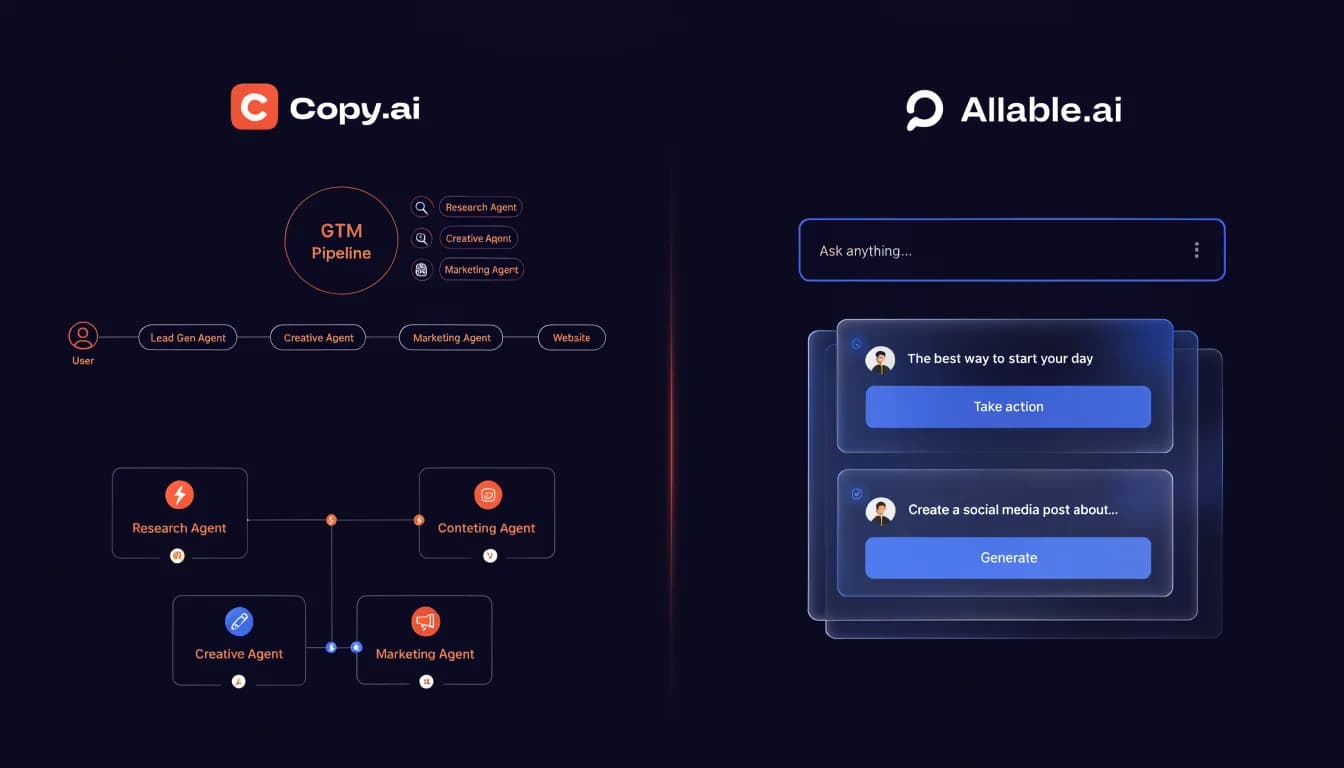
Copy.ai pivoted from AI writing tool to GTM AI Platform. Most reviews haven't caught up. Here's an honest look at whether the new version delivers — and who it's actually built for.
What Copy.ai Actually Is in 2026 — The GTM AI Pivot, Explained
Copy.ai started as an AI writing tool in 2021 and spent two years being genuinely good at it. Fast, flexible, useful for short-form copy, blog posts, and ad variations. That product still exists inside the current interface. But in 2025–2026, the company made a deliberate strategic shift.
The official positioning is now "GTM AI Platform" — go-to-market automation for the full revenue cycle. In Q2 2026, Copy.ai acquired Fullcast, a revenue intelligence and territory planning platform used by mid-market and enterprise sales teams. That acquisition signals exactly where the product is headed: sales pipeline, RevOps, and account-based marketing, not content marketing.
The Agent Suite is the product's biggest 2026 addition. It lets you build multi-agent AI workflows where specialized agents handle different stages of a sales or marketing process: one agent researches a prospect, another writes the outreach, a third personalizes it against CRM data. This is genuinely powerful if you run an SDR team or a demand generation function that bridges sales and marketing.
For a content marketer writing blog posts or social copy? The Agent Suite is mostly invisible — you'll use the same chat interface and copy templates you always did.
What this means practically:
- The interface is more complex than it was two years ago
- The feature roadmap is oriented toward GTM automation, not content creation
- The pricing tiers have shifted to reflect an enterprise buyer, not a solo marketer
- Copy.ai features for writing still work — but they haven't gotten the same investment as the GTM layer
The pivot isn't a scandal. It's a strategic product decision. But if your primary use case is marketing content — blog articles, email campaigns, ad copy — you need to know that your use case is no longer the product's priority.
Copy.ai Pricing in 2026 — What the Free Plan Gives You (and What the Paid Tiers Actually Cost)
Copy.ai redesigned its pricing in 2025, moving away from the unlimited-words model that made it popular. For a complete breakdown of every tier and what's included, see our full Copy.ai pricing guide.
Here's the current structure:
Plan | Price | Best For |
|---|---|---|
Chat (Free) | $0/month | Personal use, light experimenting |
Pro | $49/month | Individual marketers and freelancers |
Team | $249/month | Marketing teams of 3–5 users |
Enterprise | Custom | Large orgs, Agent Suite, Fullcast integration |
What changed: Copy.ai used to offer unlimited words on paid plans. That's gone. Plans now use a credit-based system, which creates usage limits that weren't there before. The shift from $49 unlimited to $49 credit-based is a meaningful reduction in value for heavy users.
The Free plan is functional — it gives you access to the chat interface and basic templates. It's good enough to evaluate whether Copy.ai fits your workflow before committing.
The Pro plan at $49/month is the most commonly purchased tier. You get full access to templates, 2,000 chat words per run, and standard integrations. For a single marketer doing mostly short-form content, it's usable. For high-volume content operations, you'll hit the credit ceiling faster than expected.
The Team plan at $249/month is where the GTM positioning becomes more visible — it includes collaboration features and workflow tools oriented toward sales + marketing alignment.
For comparison: Allable's Pro plan costs €31/month (~$33/month) and covers SEO, content creation, campaign management, analytics, and competitor research in a single platform — without credit limits on core features. If your team is paying $249/month for Copy.ai Team plus separate tools for SEO and analytics, the math shifts quickly.
Core Features Tested — What Works, What Doesn't

Copy.ai features that work well:
Short-form copy generation remains strong. Ad variations, email subject lines, product descriptions, social post drafts — the tool is fast and the output quality is usable as a starting draft. The template library covers most common marketing formats. The sentence rewriter is one of the most-used features: paste a sentence, get five alternatives in different tones. It's practical for polishing CTAs or email subject lines without rewriting from scratch.
The chat interface is intuitive. If you've used ChatGPT, the experience is familiar. Copy.ai's chat has brand voice settings that let you train the model on your tone, which helps reduce editing time on repetitive tasks.
Workflow automation (for the right use case) is the genuinely impressive new addition. If you're running a sales + marketing team and want to automate outreach sequences, prospect research, or CRM-triggered content variations, the Agent Suite delivers. It's real automation, not just templates.
Where Copy.ai falls short:
Output quality still requires significant editing. Independent analysis of Copy.ai output suggests 40–60% of content needs rewriting before it's usable. That's not unusual for AI writing tools — but it's worth naming plainly rather than hiding in a footnote. You're not getting publish-ready content; you're getting a starting point.
Long-form content is inconsistent. Blog articles generated through Copy.ai tend to be structurally thin. Sections run short, transitions feel generic, and the tool doesn't maintain a consistent argument across 1,500+ words without significant prompting. For long-form SEO content, you'll need to do more than edit — you'll need to restructure.
SEO integration is minimal. There's no built-in keyword research, SERP analysis, or content scoring. You can write about a topic, but the tool won't tell you whether you're targeting the right keyword, what the competition looks like, or whether your article structure matches search intent.
The Trustpilot signal is worth taking seriously. Copy.ai holds a 1.9/5 on Trustpilot — almost exclusively driven by billing and cancellation complaints. The G2 score (4.4/5, 2,000+ reviews) is much higher, largely because G2 skews toward B2B buyers evaluating the product on features. The split tells you something: the product works, but the customer experience infrastructure hasn't kept pace with the growth.
Copy.ai for Content Creation — Real Use Cases
If your primary job is marketing content — not sales automation — here's where Copy.ai actually fits in 2026:
Use Copy.ai for:
- Ad copy and variations. Give it a product description and a target audience, and it generates 10–15 variations in under a minute. For paid media testing, this saves real time.
- Email subject line testing. The template library for email subjects is well-trained. Fast, decent quality, genuinely useful for A/B testing hypotheses.
- Social post drafts. LinkedIn posts, Instagram captions, tweet variations — quick and serviceable. You'll edit them, but the baseline is solid.
- Repurposing structured content. If you have an existing blog post or whitepaper, Copy.ai can reformat it into shorter formats reasonably well.
Don't rely on Copy.ai for:
- SEO blog articles. The tool has no awareness of keyword difficulty, search intent, or SERP structure. You can use it for ideation or drafting, but the SEO layer is entirely missing.
- Content strategy or planning. There's no brief-generation, no cluster architecture, no competitive gap analysis. You need those inputs before Copy.ai is useful.
- Long-form thought leadership. The writing voice is competent but generic. Pieces that require a distinctive editorial angle or a consistent expert perspective don't come naturally to the tool.
The ai content creation use cases where Copy.ai shines are almost entirely high-volume, short-form, or variation-based. Teams that do mostly long-form content, SEO publishing, or editorial content will feel the ceiling quickly.
Copy.ai vs the Alternatives — Honest Comparison
The most-searched comparison in this space is Copy.ai vs Jasper — both tools started as AI writing platforms and both have evolved. Here's where they stand:
| Copy.ai | Jasper | ChatGPT | Allable |
|---|---|---|---|---|
Starting price | $49/month | $49/month | $20/month | €31/month (~$33) |
Free plan | Yes | No | Yes (limited) | Yes |
SEO integration | None | Basic (Surfer add-on, $$$) | None | Built-in |
Long-form content | Inconsistent | Better, but costly | Requires heavy prompting | Structured + SEO-aware |
Templates | 90+ | 50+ | None | Marketing-specific |
GTM/Sales automation | Strong (Agent Suite) | No | No | No |
Analytics | None | None | None | Built-in |
Best for | GTM automation | Brand governance | Flexible prompting | All-in marketing |
Copy.ai vs Jasper AI — the keyword volume on this comparison reflects a real decision teams make. Both tools cost $49/month at the base tier. Jasper has better long-form quality and brand voice controls, and it integrates with Surfer SEO (for an additional cost). Copy.ai has better sales automation through the Agent Suite. If your team is purely content-focused, Jasper edges ahead on writing quality. If you're bridging marketing and sales workflows, Copy.ai's Agent Suite is unique.
Copy.ai vs ChatGPT — ChatGPT at $20/month is more flexible and, with the right prompting, produces comparable writing output. Copy.ai's advantage is the template structure and workflow automation. If you're an advanced user comfortable with prompting, ChatGPT gives you more per dollar. If you want guardrails and templated outputs, Copy.ai is easier.
Copy.ai vs Allable — Allable is positioned as an all-in-one marketing platform, not a specialist writing tool. Where Copy.ai focuses on content generation and sales automation, Allable covers SEO research, keyword strategy, campaign management, and analytics in a single workspace. The Pro plan at €31/month (~$33) undercuts both Copy.ai Pro ($49) and Jasper Pro ($49). For teams that currently pay for Copy.ai plus a separate SEO tool, consolidating onto Allable typically reduces cost and eliminates the context-switching between tools. The trade-off: Allable doesn't have Copy.ai's GTM/Agent Suite depth for sales automation use cases.
For a full breakdown of the field, see our Copy.ai alternatives guide.
Who Should Use Copy.ai (and Who Shouldn't)
Copy.ai is the right tool if:
- You're running a sales + marketing team that wants GTM automation
- Your primary content needs are high-volume, short-form, or variation-based
- You want a dedicated workflow for outreach sequences and CRM-driven content
- Your organization is mid-market or enterprise and the $249/month Team plan is within budget
Copy.ai is the wrong tool if:
- Your primary need is SEO content — blog articles, long-form guides, keyword-driven pages
- You're a solo marketer or small team watching budget closely (the value per dollar has declined since the credit-based pricing shift)
- You need analytics, keyword research, or content performance data alongside your writing
- You were drawn in by the old "unlimited words" promise and haven't revisited the plan terms recently
The honest version: Copy.ai used to be an excellent value for content marketers. At $19–$36/month with unlimited words, it competed well against anything in the space. At $49/month with a credit cap, the calculation changes — especially when newer tools at similar or lower price points have caught up on writing quality.
If you're a marketing team without a dedicated sales ops function, the GTM pivot may have turned your writing tool into a product you're overpaying for.
Our Verdict — Is Copy.ai Worth It in 2026?
Copy.ai is a legitimately good product — for a specific buyer. If your team sits at the intersection of sales and marketing, runs account-based campaigns, or wants AI-driven GTM automation, the Agent Suite and Fullcast integration give you capabilities that no other AI writing tool offers. That's a real competitive advantage in the right context.
For the marketing team that bought Copy.ai to write faster and publish more content: the product has moved on from you. The writing features still work. The templates are fine. But the roadmap, the pricing structure, and the product's center of gravity are now pointed at the enterprise sales stack.
Our rating: 3.8/5
Dimension | Score |
|---|---|
Writing quality (short-form) | 4.2/5 |
Long-form content | 3.0/5 |
GTM automation / Agent Suite | 4.5/5 |
SEO capabilities | 1.5/5 |
Pricing value (2026) | 3.0/5 |
Customer support & billing | 2.5/5 |
The G2 score (4.4/5) reflects the product's strengths. The Trustpilot score (1.9/5) reflects the experience around the product — billing, cancellations, support responsiveness. Both are accurate. The tool works; the operational wrapper needs work.
Bottom line: If you're already on the Team plan and using the GTM features actively, Copy.ai earns its price. If you're on the Pro plan using it mainly for blog drafts and social copy, you're paying a premium for features you don't touch — and there are better-value alternatives available at the same or lower price point. For a complete comparison, see our Copy.ai alternatives guide.
Try Allable free — it handles everything Copy.ai does, plus SEO, campaigns, and analytics in one place. Start free at studio.allable.ai
Frequently Asked Questions
Is Copy.ai actually free — or are the real features behind a paywall?
Copy.ai has a free Chat plan that gives you genuine access to the core interface and template library. It's not a 7-day trial — it's a permanent free tier. The limits are meaningful (credit-based usage caps), but it's functional enough to evaluate whether the tool fits your workflow. For serious content volume or GTM automation, you'll need the Pro plan at $49/month.
Does Copy.ai have a free plan — and what does it include?
Yes. The Free plan includes access to the chat interface, 90+ templates, and basic workflow functionality. It uses a credit-based system, so heavy users will hit the limits quickly. The plan is genuinely free with no credit card required, which makes it easy to test before committing.
Is Copy.ai good for SEO content?
Honestly, no — not as a standalone tool. Copy.ai generates content, but it has no built-in keyword research, SERP analysis, or content optimization scoring. You'd need to bring your own keyword data and structure the brief manually. For SEO-first content operations, a platform with integrated SEO tooling will save you more time overall. Check our best SEO tools guide for a full comparison of what's available.
How does Copy.ai compare to ChatGPT?
For pure writing output at $20/month, ChatGPT is more flexible and, for experienced prompt writers, produces comparable quality. Copy.ai's advantages are its template structure (which speeds up common marketing formats), brand voice training, and — at the Team/Enterprise level — the Agent Suite automation. If you're new to AI writing tools, Copy.ai's guardrails help. If you're comfortable prompting, ChatGPT gives you more per dollar.
What is the Copy.ai Agent Suite?
The Agent Suite is Copy.ai's multi-agent workflow system. It lets you build automated pipelines where specialized AI agents handle sequential tasks — for example, one agent researches a prospect, another drafts personalized outreach, a third schedules follow-up. It's built for sales + marketing automation, not content creation. Teams using it for GTM workflows report strong results. Content marketers who don't run outreach automation won't interact with it at all.