
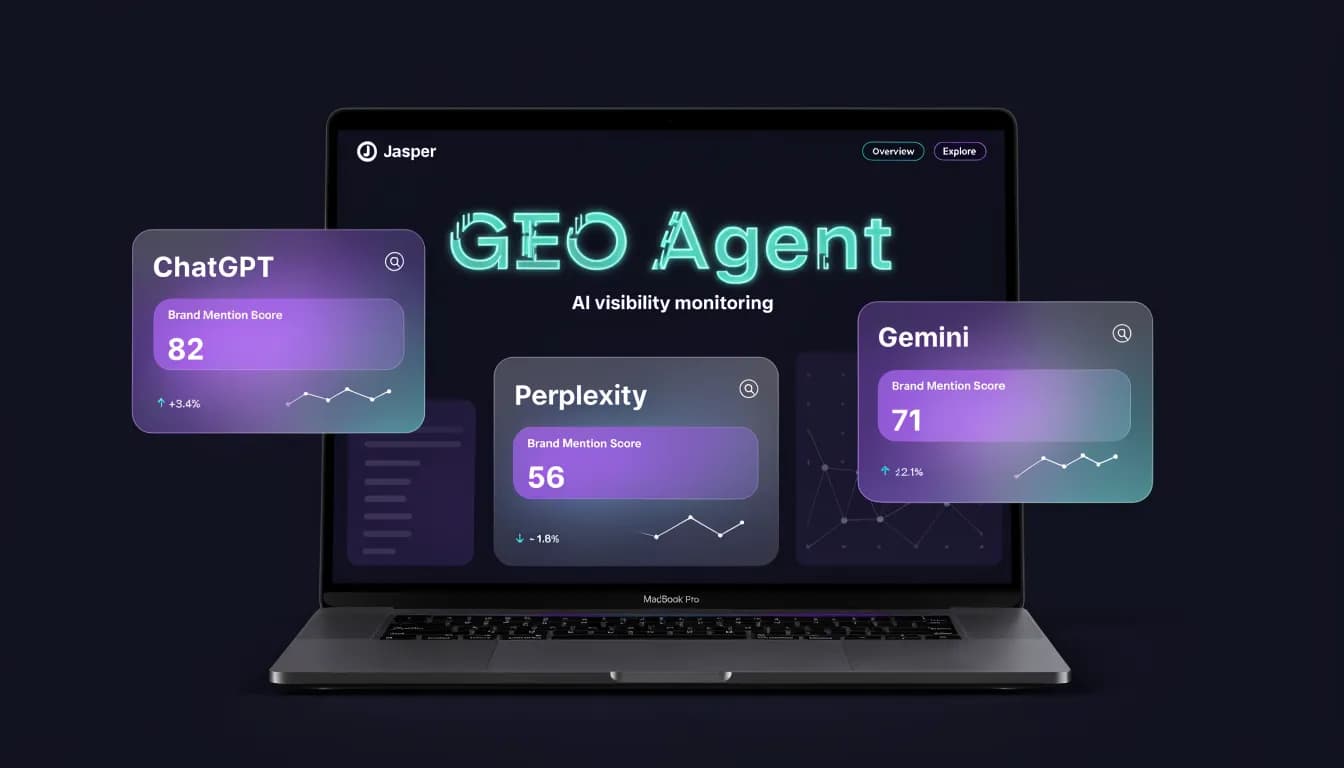
A ChatGPT answer just cited a competitor when someone asked about your product category. Not your brand — theirs. The AI pulled from a blog post you've never seen, from a site with a quarter of your domain authority. Your team spent six months producing detailed content on exactly that topic. None of it appeared. This is the problem the Jasper GEO Agent was built to solve — but whether it solves it for your team is a different question. Is paying enterprise-tier pricing for a single-purpose AI visibility agent the right move, or is it solving a problem you could address differently?
Your content is invisible in AI-generated answers, and your rankings won't tell you that.
What Is the Jasper GEO Agent? (And What "GEO" Actually Means Here)
GEO stands for Generative Engine Optimization — the practice of optimizing content so AI systems (ChatGPT, Perplexity, Google AI Overviews, Claude) cite your brand when answering relevant queries. It's distinct from traditional SEO: ranking position in a Google SERP doesn't predict whether an AI picks up your content as a source.
I covered the full conceptual breakdown in the piece on GEO vs SEO — the short version is that AI answers pull from a different set of signals than Google's ranking algorithm. Authority, citation density, factual density, and structured definitions all matter more than backlink counts or keyword density when LLMs choose what to surface.
The Jasper GEO Agent is Jasper's answer to this challenge. Launched in mid-2026 as part of Jasper's Business and Enterprise offering, it's a specialized AI workflow that monitors your brand's presence in AI-generated answers, identifies citation gaps, and rewrites or optimizes existing content to improve your chances of being cited.
In practice, the Jasper GEO Agent works on three levels:
- Detection: It queries multiple AI systems (ChatGPT, Perplexity, Google AI) for queries relevant to your brand and records whether your content is cited, mentioned, or absent.
- Diagnosis: It analyzes what your competitors are doing in cited content — structure, depth, factual density — that you're not.
- Optimization: It generates rewrite recommendations (and can execute them) to close that gap.
This is meaningfully different from what most teams are doing today: manually checking whether their brand appears in AI answers, which doesn't scale. The agent automates the monitoring loop so your content team gets actionable data instead of guesswork.
If you want a broader comparison of how different tools approach this space, the best AI visibility tools roundup covers the landscape.
What the Jasper GEO Agent Actually Does: Feature Breakdown
Let me be specific about what's included, because the marketing copy is deliberately vague.
AI citation monitoring is the core function. The agent runs automated query sets — based on your brand, product category, and target keywords — across ChatGPT, Perplexity, and Google AI Overviews. It logs whether your content is cited, which sources are being cited instead, and how frequently. You get a citation share metric rather than a position ranking. Think of it as share of voice, but for AI-generated answers rather than paid or organic search.
Competitive citation analysis shows you which specific pieces of competitor content are being cited for queries where you should appear. This is genuinely useful. If a competitor's 2023 blog post consistently outperforms your more recent, more detailed guide, the agent identifies structural or content differences that might explain why.
Content optimization recommendations are generated automatically when the agent detects a gap. These recommendations focus on things that improve LLM citation likelihood: clearer entity definitions, direct answers in the first paragraph, structured data cues, and factual citations with named sources. The recommendations can be pushed into Jasper's editor for a writer to implement, or — for teams with appropriate permissions — automatically applied.
Tracking over time gives you a citation trend line. Did last month's content refresh improve your citation rate? Did a competitor's new article erode your share? The agent tracks this weekly.
What the GEO Agent doesn't do: it won't fix your website's technical infrastructure, it won't build backlinks, and it doesn't replace your content strategy. It's a focused tool for one part of the AI visibility problem.
For context on the distinction between GEO and its cousin AEO vs GEO (Answer Engine Optimization), the approaches overlap but target different surfaces — GEO is broader, AEO is more narrowly focused on zero-click answer boxes. The Jasper GEO Agent primarily targets GEO use cases.
Jasper GEO Agent Pricing: What Does It Cost?
Here's where the conversation gets difficult for most teams. The Jasper GEO Agent is not available on Jasper's Creator plan ($49/month) or Teams plan ($69/seat/month, billed annually). It's a Business and Enterprise feature — which means pricing starts at custom quotes.
Jasper's Business plan is priced individually and typically starts at $125/seat/month for smaller teams, with volume discounts for larger organizations. Enterprise pricing (where the GEO Agent's full feature set lives) requires a sales conversation. Based on publicly available information, enterprise contracts typically start in the $500–$1,000+/month range for teams of 5+.
To put that plainly: if you want the Jasper GEO Agent, you're committing to Jasper's enterprise ecosystem. There's no standalone GEO Agent purchase, no freemium access, and no self-serve trial.
This isn't unusual for enterprise software — but it's worth naming explicitly because a lot of teams encounter the GEO Agent in Jasper's marketing and assume it's available at their current plan tier. It isn't.
The pricing structure makes sense for companies spending $10,000+ per month on content production, where a 20% improvement in AI citation share translates to measurable brand lift. For teams under that threshold, the ROI math gets harder.
Who Is the Jasper GEO Agent Actually For?
The Jasper GEO Agent fits a specific profile. Your team probably matches it if:
You're a B2B SaaS or enterprise brand with active thought leadership content and a defined competitive set. GEO optimization requires enough existing content that the agent has something to analyze and optimize — if you have fewer than 50 published pieces, you're likely not ready for this workflow.
Your marketing team has dedicated AI/SEO resources. The GEO Agent surfaces insights and generates recommendations — acting on them still requires a writer, an editor, and someone who understands what the agent is telling you. This isn't a plug-and-play tool; it's a sophisticated assistant for a sophisticated team.
You're already a Jasper customer or evaluating Jasper Business/Enterprise. If you're not in Jasper's ecosystem, adopting the GEO Agent means adopting Jasper wholesale. For some teams that's a natural fit. For others, it's a significant platform commitment just to get one capability.
You have a measurable AI visibility problem. If you've done even basic ChatGPT visibility tracking and confirmed that competitors are being cited where you should be, the GEO Agent addresses a documented problem. If you're acting on assumption, it might be premature.
The profile it doesn't fit: SMBs, solo marketers, teams early in their content journey, or anyone who needs a full marketing platform rather than a single specialized agent.
Jasper GEO Agent vs Allable: Two Different Approaches to AI Visibility

Comparing the Jasper GEO Agent to Allable isn't a pure apples-to-apples comparison — they're built on different premises. But the comparison is worth making because many teams evaluating the GEO Agent are actually asking a broader question: how do I get my content into AI answers?
Jasper GEO Agent is a single-purpose agent within a larger content platform. Its strength is depth: citation monitoring across multiple AI systems, competitive gap analysis, and automated optimization recommendations — all tightly integrated into Jasper's enterprise content workflow. The limitation is scope: it's one tool in a $125+/seat platform, optimizing for one outcome.
Allable takes a different approach. Rather than a standalone GEO agent, AI visibility optimization is one module within a platform that covers SEO research, content creation, competitor analysis, campaigns, and analytics. At Pro (€31/month, approximately $33 USD) or Business (€91/month, approximately $98 USD), you get the full platform — not a single feature at enterprise pricing.
The honest trade-off:
| Jasper GEO Agent | Allable |
|---|---|---|
Primary use | AI citation monitoring + optimization | Full-stack marketing platform |
AI visibility features | Deep, agent-driven | Integrated, part of broader workflow |
Pricing entry point | ~$125/seat/month (Business) | €31/month (Pro) |
Target user | Enterprise content teams | Marketing teams, agencies, SMBs |
Content creation | Yes (Jasper's editor) | Yes (AI-native, multi-format) |
SEO + keyword research | Basic | Full (with DataForSEO integration) |
Self-serve | No (enterprise sales required) | Yes |
If you're an enterprise team with an existing Jasper contract and a documented AI visibility gap, the GEO Agent makes sense as a capability upgrade. If you're evaluating from scratch — especially if you need AI visibility and content creation and SEO in a single, affordable workflow — a platform approach like Allable is worth comparing first.
You can read a fuller breakdown of Jasper's positioning in our Jasper AI review.
What's Missing: Limitations and Honest Gaps
No first-look review of the Jasper GEO Agent would be complete without addressing what Jasper's own marketing doesn't emphasize.
The agent can't create content from scratch. It optimizes existing content. If your content gaps are structural — you haven't written about a topic that matters for AI citation — the GEO Agent identifies the gap but can't fill it without a writer. You still need content production capacity.
Citation monitoring is a lagging indicator. There's a delay between publishing optimized content and seeing that content appear in AI answers. The feedback loop is slower than traditional SEO — weeks rather than days. The agent's tracking helps you see trends, but you won't get real-time confirmation that a specific change worked.
LLM behavior is not deterministic. AI answers vary by user, query phrasing, geography, and model version. The GEO Agent tracks trends across a defined query set, which is valuable — but it can't guarantee citation outcomes because the underlying models don't operate on guarantees. This is a fundamental limitation of the GEO category, not specific to Jasper, but it's worth being explicit about.
Platform lock-in is real. Your citation data, competitive analysis, and optimization history live inside Jasper. If you switch platforms, you lose your GEO Agent data and have to rebuild the monitoring baseline from scratch.
No standalone trial. Most enterprise software offers at least a scoped POC or pilot program. Based on current public information, the Jasper GEO Agent requires a full Business or Enterprise commitment before you can validate whether it moves the needle for your specific content set.
Verdict: Is the Jasper GEO Agent Worth It?
The Jasper GEO Agent is a genuinely useful tool for a narrow profile of teams. If you're an enterprise brand, already in the Jasper ecosystem, with documented AI visibility gaps and a content team capable of acting on agent recommendations — it delivers real value. The citation monitoring alone is something most teams are doing manually (or not doing at all), and automating that loop saves meaningful time.
For everyone else, the calculus is harder. The pricing effectively limits the GEO Agent to teams with substantial content budgets. The single-purpose nature means you're paying enterprise rates for one capability. And the platform dependency means the GEO Agent only makes sense if Jasper as a whole makes sense for your team.
The broader takeaway: GEO optimization as a practice is no longer optional for brands competing in AI-influenced search. How you get there — dedicated agent, integrated platform, or internal workflow — depends on your team's size, budget, and existing stack.
If you're still evaluating your options, start with the fundamentals of GEO vs SEO to understand what you're actually optimizing for. Then compare purpose-built tools against full-platform approaches before committing to an enterprise contract.
Frequently Asked Questions
- What is the Jasper GEO Agent?
- The Jasper GEO Agent is an AI-powered workflow tool within Jasper's Business and Enterprise platform that monitors your brand's citation presence in AI-generated answers (ChatGPT, Perplexity, Google AI Overviews), identifies competitive gaps, and generates content optimization recommendations to improve your likelihood of being cited. It's part of Jasper's broader push into Generative Engine Optimization (GEO).
- How much does the Jasper GEO Agent cost?
- The Jasper GEO Agent is not available on Jasper's base plans (Creator at $49/month or Teams at $69/seat/month). It requires the Business plan, which starts at approximately $125/seat/month, or an Enterprise contract with custom pricing. There is no standalone purchase option or self-serve trial for the GEO Agent specifically.
- How is the Jasper GEO Agent different from regular SEO tools?
- Traditional SEO tools optimize your content for Google's ranking algorithm — keyword placement, backlink authority, technical factors. The Jasper GEO Agent optimizes for AI citation likelihood, which operates on different signals: factual density, direct definitions, structured content, and source credibility as interpreted by language models. A page that ranks #1 on Google may still be invisible in AI-generated answers, and vice versa.
- Is the Jasper GEO Agent available to small businesses?
- In practice, no. The pricing model (Business/Enterprise only) puts the GEO Agent outside the budget of most small businesses. Teams with fewer than 5 seats and content budgets under $5,000/month would likely find more value in a full-platform solution that includes AI visibility features alongside content creation, SEO, and analytics — at a fraction of the cost.
- What's the difference between GEO and AEO?
- GEO (Generative Engine Optimization) broadly targets visibility in AI-generated answers across platforms — ChatGPT, Perplexity, Google AI Overviews, and similar. AEO (Answer Engine Optimization) is more narrowly focused on zero-click answer formats, particularly Google's featured snippets and knowledge panels. The Jasper GEO Agent primarily addresses GEO use cases. You can read a full breakdown in our piece on AEO vs GEO (/blog/aeo-vs-geo/).
See How Allable Handles AI Visibility
GEO optimization doesn't have to mean enterprise pricing. Allable includes AI visibility workflows, SEO research, content creation, and competitor analysis — all in one platform starting at €31/month. No sales call required.