
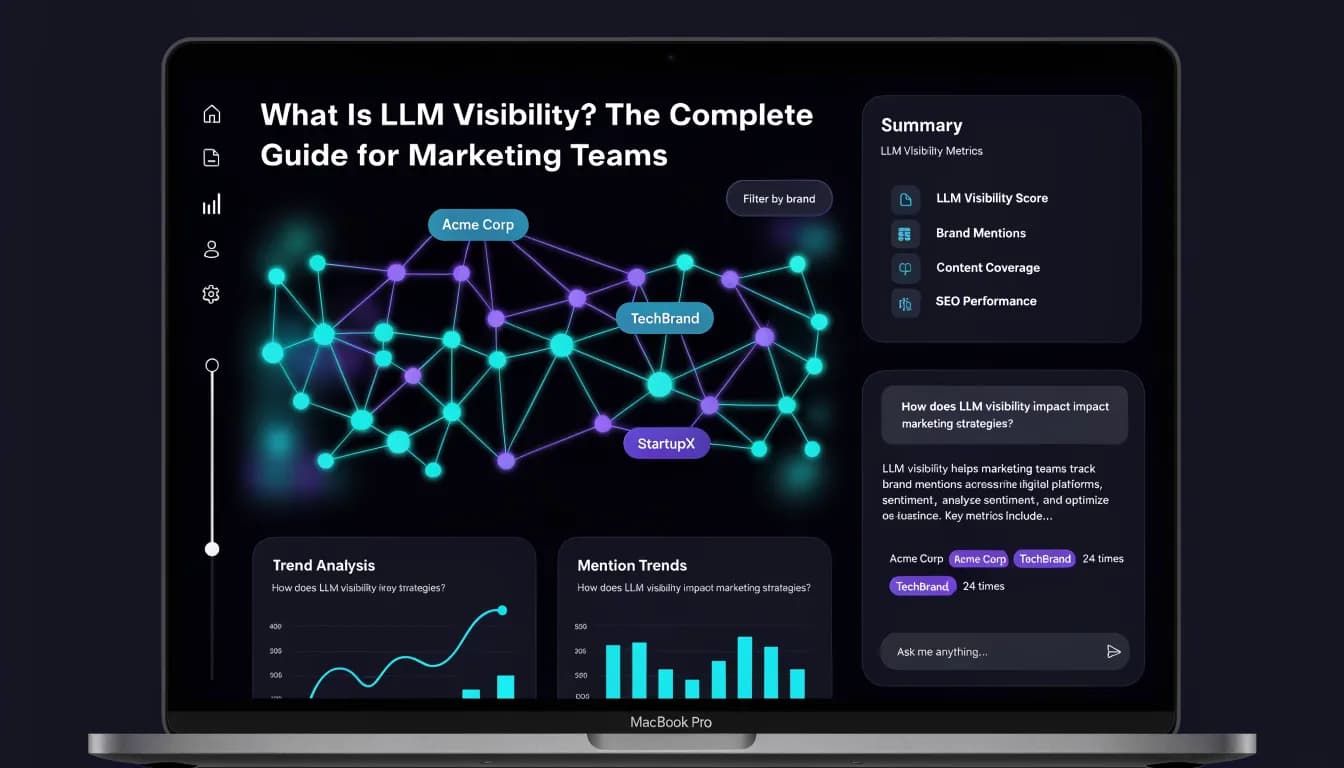
You rank on Google but may be invisible in ChatGPT, Perplexity, and Gemini — where buyers form shortlists. LLM visibility measures how often AI models mention your brand. This guide covers what it is, why it matters, and how to build it.
Your most carefully optimized pages may be ranking #1 on Google and completely absent from the answers your future customers are actually reading. Not because your content is bad — it isn't. Because a different game is being played in parallel, with different rules, different referees, and different winners. Every time someone asks ChatGPT, Claude, or Perplexity which tool to use, which brand to trust, or which approach actually works — your brand either shows up or it doesn't. And right now, most marketing teams have no visibility into which of those it is.
That gap has a name: LLM visibility. And understanding it is about to become one of the most important things your marketing team does in 2026.
What Is LLM Visibility?
LLM visibility refers to how frequently and favorably your brand, product, or content appears in the responses generated by large language models — tools like ChatGPT, Claude, Gemini, Perplexity, and Copilot.
When a user asks "What's the best AI writing tool for content teams?" or "Which SEO platform gives the most accurate keyword data?", the LLM synthesizes an answer from its training data, retrieved web content, and learned associations. The brands that appear in that answer have LLM visibility. The ones that don't — regardless of their Google ranking — are invisible at that moment of decision.
This is not a theoretical problem. A 2024 study by Semrush found that AI Overviews on Google now appear for over 47% of queries in the US. Perplexity alone processes over 100 million queries per month. ChatGPT's user base surpassed 200 million weekly active users in late 2024. These are not niche platforms. They are becoming primary information surfaces for the exact buyers your marketing funnel is designed to reach.
LLM visibility is distinct from three things it's often confused with:
- Traditional SEO — where you optimize for search engine crawlers indexing your pages
- Paid advertising — where you buy placement in exchange for budget
- Social reach — where visibility depends on algorithmic amplification
In LLM-generated responses, none of those levers work directly. The LLM doesn't care how many backlinks you have unless those backlinks signal genuine authority that shaped its training data. It doesn't show your ad just because you're bidding on a keyword. It answers the question in front of it using the most reliable, citation-worthy, contextually relevant information it can access — and your job is to be part of that information.
LLM Visibility vs. AI Visibility vs. GEO vs. AEO — What's the Difference?
The terminology in this space is evolving fast, and the inconsistency creates real confusion in marketing teams trying to prioritize. Here's how to think about each term:
AI Visibility
AI visibility is the broadest term. It describes how visible your brand is across all AI-powered surfaces — including AI-generated search results (Google AI Overviews), LLM chatbots (ChatGPT, Claude, Perplexity), AI-powered recommendation engines, and voice assistants. If LLM visibility is a subset, AI visibility is the parent category.
GEO — Generative Engine Optimization
GEO is the practice of optimizing your content to appear in AI-generated search results, specifically in generative search engines like Google's AI Mode and Bing Copilot. It borrows heavily from traditional SEO but focuses on how AI synthesizes and presents information. A useful distinction: GEO targets the interface between search engines and AI generation. LLM visibility targets standalone AI models and chatbots.
AEO — Answer Engine Optimization
AEO is older than GEO and focuses on getting your content featured in direct answer boxes, featured snippets, and voice search results. It was primarily about structured content, schema markup, and being the single best answer to a specific query. AEO overlaps with GEO but predates the current generative AI wave — and while structured data still matters, the signals LLMs use go beyond what AEO alone covers.
LLM Visibility (specific)
LLM visibility is specifically about standalone large language model platforms — ChatGPT, Claude, Gemini (in direct API/app use), Perplexity, and similar tools. Unlike GEO, which focuses on search-integrated AI, LLM visibility deals with models that may use retrieval-augmented generation (RAG), real-time web access, or purely their training weights to generate responses. The signals that drive LLM visibility are different, the measurement approach is different, and the optimization tactics have unique elements not covered by GEO or AEO frameworks.
The practical implication: your team needs a strategy that addresses all four layers — but if you had to pick one emerging priority for 2026, LLM visibility is where the least-optimized gap exists and where first-mover advantage is still very much available.
How LLMs Decide What to Cite

This is the part most marketing content skips, and it's the part you actually need to understand before any tactic makes sense. LLMs don't rank pages. They generate responses. The mechanisms that drive what they say — and who they mention — are fundamentally different from how Google's PageRank works.
Training Data and Pre-Training Weights
Every LLM is trained on a corpus of text that shapes its baseline knowledge. GPT-4's training data has a knowledge cutoff. Claude's does too. What appeared in that training data — and how frequently, consistently, and authoritatively — influences which brands and concepts the model "knows about" at baseline. If your brand has been consistently mentioned in authoritative publications, industry reports, and expert-written content that was part of the training corpus, you have a structural advantage that persists even without real-time retrieval.
This is why earned media, thought leadership articles in industry publications, and consistent expert coverage matter for LLM visibility in a way they stopped mattering quite as much for classic SEO (where freshness and links dominate).
Retrieval-Augmented Generation (RAG)
Many modern LLM deployments — including Perplexity, ChatGPT with web browsing, and Bing Copilot — use RAG: they retrieve relevant web documents at query time and use those documents to ground their answers. This is where traditional SEO signals re-enter the equation: if your content is indexed, topically relevant, and structured for readability, it's more likely to be retrieved and cited.
RAG-based LLMs cite sources. This creates a measurable signal for LLM visibility: citation rate. Tracking how often your domain appears as a cited source in Perplexity or ChatGPT answers is one of the most direct measures of LLM visibility you can collect.
Authority and Consistency Signals
LLMs learn associations. If thousands of documents in their training corpus associate "tool X" with "use case Y" and describe it in consistently positive terms, the model builds a strong association. Conversely, if your brand appears in only a handful of documents, or in inconsistent contexts, the model has weak signal and will default to brands with stronger associations.
This is why LLM visibility is not just about content volume — it's about content consistency, topical depth, and the quality of third-party references. A single 5,000-word guide doesn't build LLM visibility. A consistent body of authoritative, well-cited, topically coherent content does.
Real-Time Web Access
Some LLM deployments grant models real-time internet access. In these cases, recency matters: fresh, indexed, accessible content is more likely to be retrieved. This is where the bridge between traditional SEO (technical accessibility, crawlability, freshness) and LLM visibility is most direct.
Why Your Brand May Be Invisible to LLMs Right Now
Understanding the mechanism is one thing. Diagnosing your specific invisibility is another. Here are the most common reasons well-resourced marketing teams still end up invisible in LLM responses:
1. You've optimized for crawlers, not for language models
Google SEO rewards keyword placement, backlink authority, and technical structure. LLMs reward clarity, definitional depth, and contextual association. Content written purely for search engine crawlers — keyword-dense, structured around ranking signals — often reads poorly to language models that prioritize coherent, expert prose. If your content answers questions the way a bot expects, but not the way a human expert would actually explain something, LLMs will skip it.
2. Your brand has low training data presence
If your company is relatively new, niche, or has relied primarily on paid acquisition and SEO rather than earned media and thought leadership, your training data footprint is thin. LLMs literally don't "know" you well. No amount of on-page optimization compensates for absence from the underlying corpus.
3. You lack topical authority on your core subject
LLMs associate brands with topics based on the density and consistency of that association in their training data. If your site covers ten topics at shallow depth, the model doesn't build a strong association between your brand and any of them. Deep, comprehensive content on your core subject — content that other sources reference and build on — creates the topical authority that LLMs respect.
4. Your structured data doesn't tell the right story
LLMs that use RAG pay attention to structured, easily-parseable information. Schema markup, clear entity definitions, concise factual statements, and well-organized headers help models extract accurate information about your brand, product, and expertise. Unstructured prose blobs — even well-written ones — are harder for models to reliably extract specific claims from.
5. Third-party coverage is sparse or inconsistent
Your own content can only do so much. If independent reviews, comparison articles, industry analyses, and expert mentions don't consistently describe your brand in ways that reinforce your positioning, LLMs receive mixed signals. In the absence of strong third-party signal, they default to more heavily-covered alternatives.
5 Ways to Improve LLM Visibility for Your Brand
These aren't experimental tactics. Each maps directly to one of the LLM citation mechanisms described above.
1. Build Definitional Content on Your Core Topics
LLMs are, at their core, very good at explaining things. When a model encounters a query about a concept your brand owns, the ideal outcome is that it draws on your content to frame its explanation. This requires you to publish clear, comprehensive, definitionally rich content on the concepts you want to own. Not just "how to use X" — but "what is X, why does it matter, how does it work, what are the alternatives."
This pillar you're reading right now is an example of that approach. A brand that publishes the most complete, accurate, and well-structured definition of "LLM visibility" creates the kind of content that LLMs are likely to reference when answering questions about that concept.
Tactic: Identify 5–10 concepts that sit at the center of your category. For each one, publish a definitional guide that covers the concept from first principles. Make it citation-worthy: include data, define terminology precisely, address related concepts, and structure it clearly.
2. Earn Consistent Third-Party Mentions
Because LLMs weight training data from across the web, your brand's mention in publications, review sites, comparison articles, and expert analyses has compounding value. Every authoritative mention is a signal that helps the model build stronger, more consistent associations with your brand.
Tactic: Run a systematic PR and content partnership program specifically targeting publications and sites likely to be in LLM training data: industry publications, respected comparison sites, expert-authored newsletters, and high-authority review platforms. A review on G2, an analysis in a respected industry newsletter, a mention in a well-cited research report — each of these builds LLM signal in ways that a hundred low-quality backlinks never will.
3. Optimize for Citation Structure (Not Just Keywords)
For RAG-based LLMs, your content needs to be citation-ready. That means: concise factual statements that can be extracted cleanly, clear source attribution for statistics and claims, well-labeled sections with descriptive headings, and formatting that makes information easy to retrieve and summarize.
Tactic: Audit your most important pages for citability. Can a language model extract a clean, accurate sentence summarizing your core value proposition? Is your pricing stated clearly? Are your feature differentiators described in precise, non-jargon language? Treat your most important pages as if a model will extract 2–3 sentences from them to answer a specific question — and make sure those sentences are there.
4. Publish Consistent, Topically Coherent Content
Sparse content in a broad topic area creates weak signal. Deep content in a focused topic area creates strong association. A marketing analytics platform that publishes 80 articles covering everything from social media to HR software sends a confusing signal. A platform that publishes 80 deeply researched articles on marketing analytics, attribution, and campaign measurement becomes strongly associated with that topic.
Tactic: Run a content gap analysis against your core topic cluster. Identify sub-topics where you have shallow coverage or none. Close those gaps systematically. Every new piece of topically coherent content reinforces the model's association between your brand and your subject matter.
5. Monitor and Respond to LLM Sentiment
LLM visibility isn't just about appearing — it's about appearing in a positive, accurate context. Models can perpetuate outdated pricing information, incorrect feature descriptions, or unfavorable positioning absorbed from negative reviews. Active monitoring lets you identify inaccuracies in how LLMs describe your brand and respond by publishing accurate, authoritative content that corrects the record.
Tools like Scrunch AI allow you to query multiple LLMs systematically and track how your brand appears over time — including the specific language models use to describe you and the context in which your brand comes up (or doesn't).
Metrics: How to Measure LLM Visibility

Traditional SEO has well-established metrics: rankings, organic traffic, click-through rate, domain authority. LLM visibility measurement is newer, but a practical measurement framework is emerging. Here's what your team should be tracking:
Brand Mention Rate
How often does your brand appear when LLMs answer queries in your category? This is the foundational metric. Define a set of representative queries ("best [category] tools," "alternatives to [competitor]," "[problem] solution"), run them systematically across target LLMs, and track your mention rate over time.
Benchmark: If your brand doesn't appear in at least 30% of category queries across your target LLMs, you have a significant LLM visibility gap relative to category leaders.
Citation Rate (RAG-Enabled LLMs)
For Perplexity, ChatGPT with web access, and similar tools, track how often your domain appears as a cited source. This is the clearest signal that RAG-based LLMs are retrieving and using your content.
Share of Voice in LLM Responses
Of the brands mentioned in LLM answers to your category queries, what percentage is yours versus competitors? LLM share of voice is an emerging competitive metric that provides context for your raw mention rate.
Sentiment and Accuracy Score
When your brand does appear, how is it described? Is the pricing accurate? Are the features described correctly? Is the positioning favorable? Manual spot-checking combined with systematic sentiment tracking gives you a quality dimension to pair with your volume metrics.
Position in Response
In multi-brand LLM responses (e.g., "top 5 tools for X"), order matters. Being mentioned first or second carries more weight than a fifth mention. Track your typical position in multi-brand responses over time.
Tools for LLM Visibility Tracking
The LLM visibility tooling market is early but growing fast. These are the most meaningful options available as of mid-2026:
Scrunch AI
Scrunch AI is one of the earliest dedicated platforms for LLM visibility monitoring. It allows you to define a set of queries, run them against multiple LLMs simultaneously, and track brand mention rates, sentiment, and citation frequency over time. Our full Scrunch AI review covers its capabilities and limitations in detail. It's a strong starting point for teams investing seriously in LLM visibility monitoring.
Profound
Profound focuses on enterprise-grade LLM visibility analytics, providing share-of-voice data across ChatGPT, Claude, Perplexity, and Gemini. It's positioned for larger brands with significant category competition and includes competitive benchmarking features.
Otterly.ai
Otterly.ai is a newer entrant with a focus on tracking AI brand mentions across multiple LLM platforms. It offers monitoring alerts when your brand appears or disappears from LLM responses to key queries — useful for tracking changes after content or PR campaigns.
Allable.ai
Allable includes LLM and AI visibility tracking as part of its broader marketing intelligence suite. You can monitor your brand's ChatGPT and Perplexity visibility alongside traditional SEO metrics, competitor tracking, and content performance — without needing to switch between five specialized tools. Plans start at Free forever, with the Pro tier at €31/month covering full AI visibility monitoring for most mid-size marketing teams.
Manual Query Sampling
For teams not ready to invest in dedicated tooling, a structured manual sampling process — defining 20–30 representative queries, running them weekly across 3–4 target LLMs, and logging results in a shared spreadsheet — provides a baseline read on LLM visibility. It doesn't scale, but it builds intuition and helps prioritize where to invest.
LLM Visibility Strategy for 2026
The strategic question isn't whether LLM visibility matters — it does, and the evidence is clear. The question is how to sequence your investment given real resource constraints. Here's a practical strategic framework for marketing teams building their LLM visibility playbook in 2026:
Phase 1 — Measure Before You Optimize (Weeks 1–4)
Before deploying content or PR resources, understand your current LLM visibility baseline. Define your core query set (20–40 queries representing real decision-making moments in your category). Run them across ChatGPT, Claude, Perplexity, and Gemini. Document mention rate, position, and sentiment. This baseline is your starting point for measuring the impact of everything you do next.
Most teams skip this step. Don't. Without a baseline, you're optimizing blind.
Phase 2 — Close the Most Critical Content Gaps (Weeks 4–12)
Using your baseline data, identify which query types produce zero or near-zero brand mentions. These are your highest-priority content gaps. Typically, they fall into two categories:
- Definitional gaps: you have no authoritative content on a core concept in your category
- Comparison gaps: LLMs don't include your brand when answering "X vs Y" or "best alternatives to Z" queries
Close definitional gaps with pillar content. Close comparison gaps with dedicated comparison and alternative pages, plus a systematic effort to get your brand mentioned in existing high-authority comparison content published by third parties.
Phase 3 — Earn Consistent Third-Party Signal (Ongoing)
Content you publish yourself is table stakes. What scales your LLM visibility is consistent third-party mention — in places that are indexed, authoritative, and likely to be in or retrieved by LLM training pipelines. This means:
- Targeted digital PR to industry publications
- Outreach to comparison and review sites in your category
- Active management of your G2, Capterra, and similar review profiles
- Thought leadership contributions (bylines, expert quotes, podcast appearances)
None of these is new. What's new is that their LLM signal value is now as important as — arguably more important than — their direct SEO value.
Phase 4 — Iterate Based on LLM Response Data (Monthly)
Run your query set monthly. Compare mention rate, position, and sentiment against baseline. Attribute changes to specific interventions (new content published, PR placements, product coverage). Refine your content and PR priorities based on what's actually moving the needle.
LLM visibility optimization is a feedback loop, not a one-time project. Integrating your LLM tracking with your broader SEO and content analytics — in a single dashboard rather than scattered across tools — dramatically reduces the overhead of maintaining this discipline at scale.
LLM visibility is one of the fastest-moving areas in marketing right now — and the teams that build systematic measurement and optimization processes today will have a meaningful structural advantage within 12 months. The window for first-mover positioning in most categories is open, but it won't stay open indefinitely.
Frequently Asked Questions
- What is LLM visibility in simple terms?
- LLM visibility is how often and how favorably your brand appears in the answers that AI chat tools — like ChatGPT, Claude, and Perplexity — give to users. When someone asks an AI assistant which tool to use in your category, your LLM visibility determines whether your brand shows up in that answer or not.
- Is LLM visibility the same as SEO?
- No, though they overlap. Traditional SEO optimizes for search engine ranking pages — where Google or Bing ranks your content. LLM visibility is about appearing in AI-generated answers, where the mechanism is fundamentally different: LLMs don't rank pages, they generate responses based on training data, retrieval, and learned associations. Good SEO helps LLM visibility indirectly, but you need additional tactics specifically targeting how LLMs source and cite information.
- How do I know if my brand has an LLM visibility problem?
- The clearest test: go to ChatGPT, Claude, and Perplexity and ask 10 questions a real buyer in your category might ask. 'What's the best [your category] tool?' 'What are the top alternatives to [your main competitor]?' 'What should I use for [specific use case]?' If your brand doesn't appear in at least half of those answers, you have an LLM visibility gap. The next step is to measure it systematically rather than by spot-check.
- How long does it take to improve LLM visibility?
- Faster than you might expect for RAG-based LLMs (Perplexity, ChatGPT with web access), because those models retrieve current web content. If you publish strong, authoritative, citation-ready content today and it gets indexed, RAG-based LLMs can begin citing it within weeks. For base model LLMs (those running on training data alone without real-time retrieval), changes take longer because they depend on training data updates, which happen on a model's release cycle. Realistically, expect 30–90 days for measurable improvement in RAG-based LLM visibility from content interventions, and longer for training-data-only models.
- Does social media presence affect LLM visibility?
- Indirectly. Social media content itself is typically not in LLM training corpora (except for public platforms that were part of training datasets). But strong social presence drives secondary effects that do matter: it increases brand search volume (a signal of brand authority), generates mentions and links from third-party content, and amplifies the reach of your authoritative content. High social engagement on your best content means more people read it, share it, and cite it — all of which builds the web-wide signal that LLMs ultimately weight.