
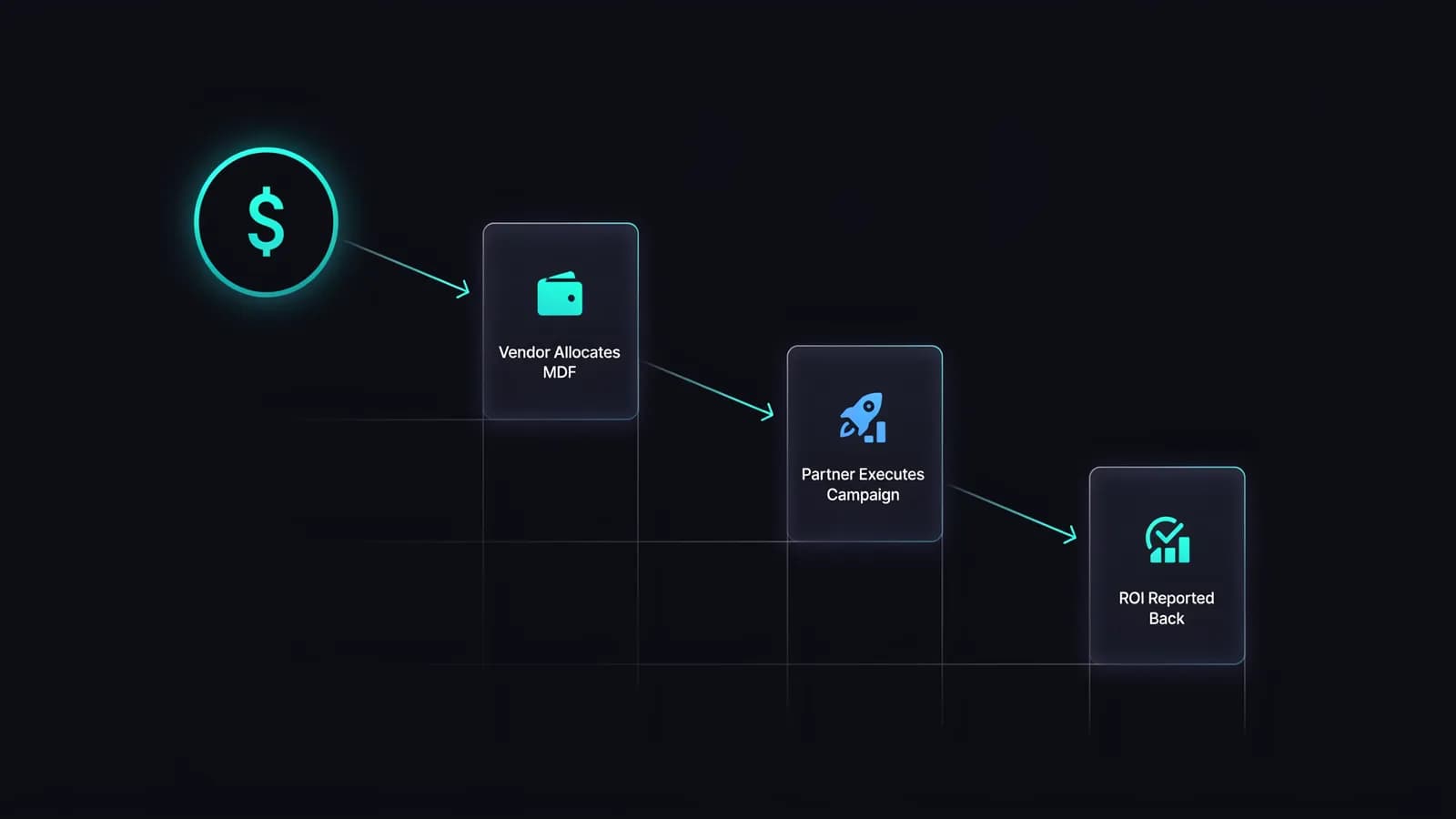
Most channel partners qualify for MDF but never claim it. Why? Not because the money isn't there — vendors allocate billions every year. The real barrier is knowing how to propose, execute, and document campaigns in a way that actually gets approved.
Marketing development funds (MDF) are one of the most underused benefits in B2B channel partnerships. Partners leave millions of dollars unclaimed every year, not because they don't qualify, but because they don't know how to request MDF properly, what it can fund, or how to prove ROI to avoid clawbacks.
This guide walks you through exactly how MDF works from the partner side — from your first request to final reporting.
What Are Marketing Development Funds (MDF)?
Marketing development funds are budgets that vendors, manufacturers, or distributors allocate to their channel partners — resellers, managed service providers (MSPs), distributors, and value-added resellers (VARs) — to pay for marketing activities that promote the vendor's products and generate demand.
Put simply: your vendor sets aside money for you to spend on marketing. You don't earn a commission on it. You apply for it, spend it on approved activities, and document the results.
MDF programs exist because vendors rely on channel partners to reach markets they can't serve directly. Instead of building local sales and marketing teams in every geography or vertical, vendors fund their partner network to do that work. It benefits both sides: you get a budget to run campaigns you couldn't otherwise afford; they get market coverage at scale.
Common MDF-eligible activities include:
- Digital advertising (paid search, LinkedIn, display)
- Events, trade shows, and webinars
- Content creation (white papers, case studies, landing pages)
- Email marketing campaigns
- Social media promotion
- Demo equipment and proof-of-concept setups
- Sales enablement materials
The specific list depends on your vendor's program rules — always confirm what's approved before spending.
MDF vs Co-op Advertising: What's the Difference?

These two terms get used interchangeably, but they are not the same thing. Understanding the distinction matters because they have different application processes, reporting requirements, and strategic uses.
Co-op Advertising
Co-op advertising (or simply "co-op funds") is formula-based. You accrue co-op dollars automatically as a percentage of your past purchases from the vendor — typically 1–3% of the sales volume you generate. The formula is fixed, the accrual is predictable, and the process is largely automated.
Co-op funds are backward-looking: you earn them based on what you already sold. They're usually restricted to specific, pre-approved advertising formats — often co-branded materials, local advertising, or direct mail — where the vendor's brand must be prominently displayed.
Marketing Development Funds (MDF)
MDF is proposal-based and discretionary. You don't automatically accrue MDF. Instead, you pitch a marketing initiative to your vendor and request funding. The vendor's channel marketing team reviews the proposal, evaluates the potential return, and either approves, rejects, or modifies your request.
MDF is forward-looking: you earn it by proposing new initiatives that align with the vendor's current strategic goals. This makes it more flexible — MDF can fund a broader range of activities — but also more competitive. You're competing with other partners in the program for a limited pool of discretionary dollars.
Quick comparison:
| Co-op Advertising | MDF |
|---|---|---|
How earned | Automatic % of purchases | Proposal-based request |
Approval process | Usually pre-approved | Vendor reviews and approves |
Flexibility | Lower (restricted formats) | Higher (broader activity types) |
Predictability | High (you know the formula) | Lower (competitive, discretionary) |
Strategic alignment | Past sales performance | Vendor's current priorities |
Clawback risk | Lower | Higher (proof of performance required) |
Some vendors run both programs simultaneously. Others use "MDF" as a catch-all term for both. Always read your partner agreement carefully.
How MDF Programs Work
Before you request anything, understand how your vendor structures their MDF program. Most programs have three components:
1. Eligibility Requirements
Not every partner in a program qualifies for MDF. Vendors typically set thresholds based on:
- Partner tier (Gold, Platinum, Diamond — or equivalent)
- Certifications held by your sales and technical team
- Sales volume generated in the prior period
- Market focus alignment with the vendor's target segments
If you're at a lower tier, MDF access may be limited or unavailable. Tier up first, or ask your partner account manager whether there are programs for smaller partners — some vendors like Lenovo have introduced tiered MDF access specifically to support smaller, specialized partners.
2. Fund Allocation
Once eligible, the vendor allocates a pool of MDF for you to draw from. This might be:
- A fixed annual or quarterly budget
- A percentage of your sales with them
- Discretionary funds with no pre-set cap (you request, they decide)
In most programs, unused funds expire at the end of the quarter or fiscal year. Funds that expire are not rolled over.
3. The Request-Approve-Reimburse Cycle
MDF works on a reimbursement model in most cases — though some vendors pay upfront:
- You submit a proposal (activity description, budget breakdown, expected outcomes)
- Vendor approves or modifies the proposal
- You execute the marketing activity
- You submit proof of execution (invoices, campaign screenshots, lead lists, reports)
- Vendor reviews and reimburses — or denies, if documentation is insufficient
The documentation step is where most partners run into trouble.
How to Request MDF: Step-by-Step
Step 1: Know Your Vendor's Current Priorities
MDF proposals that align with what the vendor is trying to achieve right now win approval faster. Before writing a proposal, check your vendor's partner portal, recent announcements, and fiscal quarter messaging. Are they pushing a specific product line? Entering a new vertical? Competing against a specific rival?
Frame your proposal around those priorities.
Step 2: Build a Specific Proposal
Generic proposals get rejected. A strong MDF proposal includes:
- Activity description: What exactly you're running (e.g., a LinkedIn campaign targeting IT directors in manufacturing, with 3 promoted posts and a gated white paper download)
- Target audience: Who you'll reach and how they map to the vendor's ICP
- Budget breakdown: Line items — ad spend, content creation, event costs, platform fees
- Expected outcomes: Lead volume, impressions, pipeline contribution, or another measurable metric
- Timeline: Start date, end date, proof-of-performance submission date
- Your co-investment: Many vendors require you to match a percentage of MDF (e.g., 50/50 split)
The more specific the proposal, the faster the approval and the easier the final reporting.
Step 3: Submit Through the Right Channel
Most vendors manage MDF through a Partner Relationship Management (PRM) portal. Find the MDF or "funds request" section, attach your proposal, and submit. If your vendor doesn't have a portal, your partner account manager (PAM) is your main contact.
Submit early — MDF budgets deplete during the quarter, and late requests often get denied not because of proposal quality but because funds are exhausted.
Step 4: Get Written Approval Before Spending
Never spend money in anticipation of MDF approval. If the vendor denies the request after you've already executed the campaign, you have no recourse. Get written approval — an email confirmation from your PAM or a portal approval notification — before committing any budget.
Step 5: Execute and Document Everything
Run the campaign and capture proof as you go:
- Screenshots of live ads with spend visible
- Event photos and attendance records
- Email campaign performance reports (sends, opens, clicks)
- Lead generation reports with timestamps
- Invoices and receipts for every vendor you paid
Don't wait until the campaign ends to start documenting. Build this into your campaign execution workflow from day one.
What You Can Use MDF For (Common Approved Activities)
Every vendor program is different, but these activities are approved in the vast majority of MDF programs:
Digital demand generation
- Paid search campaigns targeting the vendor's category keywords
- LinkedIn sponsored content and lead gen forms
- Programmatic display advertising
Events and field marketing
- Industry trade shows and conferences
- Lunch-and-learn events with prospects
- Partner-hosted webinars and virtual events
- Executive roundtables
Content and creative
- Co-branded content assets (white papers, eBooks, case studies)
- Landing pages for co-branded campaigns
- Video production for product demos or testimonials
Sales enablement
- Battle cards and competitive materials
- Sales training workshops
- Demo environments and proof-of-concept equipment
Not usually approved:
- General brand advertising that doesn't mention the vendor's products
- Internal training not linked to the vendor's product line
- Capital expenditures (hardware, software licenses unrelated to the campaign)
- Salaries or overhead costs
When in doubt, ask before spending. A quick email to your PAM takes five minutes and protects you from a denied claim months later.
Common MDF Mistakes That Cost Partners Money
1. Missing the Submission Deadline
MDF must be claimed within a specific window after the activity ends — often 30 to 60 days. Partners who complete a campaign in September and assume they have until December to submit proof frequently discover the claim deadline was October 31. Set calendar reminders the moment your campaign is approved.
2. Insufficient Documentation
The #1 cause of clawbacks and denied reimbursements is documentation that doesn't meet vendor requirements. Screenshots are blurry. Invoices don't match the approved budget line items. Lead reports lack timestamps. Vendors are not lenient here — their compliance teams have strict criteria, and partial documentation usually means partial (or zero) reimbursement.
Build a documentation checklist from your vendor's claim form before you launch any activity. Know exactly what you'll need to prove and capture it live.
3. Running Unapproved Activities
Even if an activity sounds reasonable, running it before it's been approved — or pivoting mid-campaign to an unapproved format — voids your claim. If your webinar costs overrun and you shift budget from email to paid ads without updating the approval, the vendor may deny the entire claim.
Submit amendment requests before making changes. Most vendors allow modifications; they just need to approve them in advance.
4. Failing to Co-Invest
Many MDF programs require partners to contribute a matching percentage — anywhere from 25% to 50% of total campaign spend. Partners who expect full reimbursement and don't budget for their share get surprised at claim time. Read the co-investment requirements before finalizing your proposal budget.
5. Treating MDF as Free Money
The partners who get approved for MDF year after year are the ones who treat it like an investor relationship — they propose strategically, execute carefully, report thoroughly, and show results. Partners who treat MDF as a budget entitlement, submit vague proposals, and deliver thin results rarely get approved again the following year.
Your MDF track record follows you. Strong proof of performance in Q1 makes your Q2 proposal faster to approve and harder to deny.
How to Prove MDF ROI and Avoid Clawbacks
Proving ROI is the step most partners underinvest in — and it's the step that determines whether you get reimbursed, and whether you get approved again next quarter.
Define Metrics Before the Campaign Starts
Your MDF proposal already included expected outcomes. Use those as your reporting baseline. If you projected 150 leads from a LinkedIn campaign, your final report should show how many leads you generated, what their job titles were, which accounts they came from, and what entered the pipeline.
Don't define metrics retroactively. Vendors can tell.
Use Tools That Produce Auditable Reports
Spreadsheets don't hold up well in MDF claims. Use platforms that generate timestamped, export-ready reports — your ad platform (LinkedIn Campaign Manager, Google Ads), your CRM, your email platform, your event registration system. These produce the format vendors expect.
AI marketing platforms like Allable consolidate campaign execution, performance tracking, and reporting in one place — which means your proof-of-performance documentation is generated as a byproduct of running the campaign, not assembled manually at claim time. That's a meaningful operational advantage when you're managing multiple active MDF campaigns simultaneously. Learn more about how AI-powered marketing strategy works in practice.
Report More Than You Were Asked To
Vendors expect the minimum: spend, activity proof, lead count. Partners who provide more — pipeline influenced, deals closed from MDF leads, customer lifetime value of acquired accounts — build a reputation as high-ROI partners. That reputation translates directly into larger MDF allocations in future quarters.
Submit Claims Early
Don't wait until the deadline. Submit your claim as soon as you have complete documentation. Vendors process claims in batches, and claims submitted close to the deadline compete with everyone else's last-minute submissions. Early submission also gives you time to respond to documentation requests if the vendor needs additional information.
How AI Marketing Platforms Help You Maximize MDF
Running MDF campaigns efficiently is harder than it looks. You're managing proposal submissions, multi-channel campaign execution, lead tracking, documentation collection, and performance reporting — often across multiple vendors simultaneously, each with different program rules and claim formats.
This is exactly the kind of operational complexity that AI marketing platforms are built to reduce. Rather than stitching together five separate tools — a project manager, an ad platform, a CRM, a reporting dashboard, and a document storage system — an integrated platform handles the full MDF campaign lifecycle in one place.
With Allable, for example, you can plan and brief MDF campaigns, manage paid and content distribution, track leads back to the originating campaign, and generate the performance reports your vendor requires — all without switching tools. The result is faster execution, less manual documentation work, and a cleaner paper trail that holds up to vendor scrutiny at claim time. If you're looking for tools that help with AI enablement for marketing teams, an integrated approach to MDF campaign management is one of the most immediate ROI use cases.
The partners who maximize MDF aren't the ones with the biggest marketing teams. They're the ones with the best systems for proposing, executing, and proving results. AI tools level that playing field. You can read more about building those systems in our guide to the best AI SEO tools and how they fit into a broader channel marketing stack.
MDF FAQ
What does MDF stand for?
MDF stands for Marketing Development Funds (sometimes called Market Development Funds — both terms are used). It refers to the budget vendors allocate to channel partners to fund marketing activities that promote the vendor's products and generate demand.
Is MDF the same as co-op advertising?
No. Co-op advertising accrues automatically based on a formula tied to your past sales volume and is typically restricted to specific co-branded ad formats. MDF is discretionary — you apply for it by submitting a proposal, and the vendor decides whether to fund it. MDF is generally more flexible and can cover a broader range of marketing activities.
What happens if I don't use my MDF?
Unused MDF typically expires at the end of the quarter or fiscal year and is not rolled over. Once the funds lapse, they return to the vendor's pool. This is why it pays to plan MDF campaigns early in the quarter rather than scrambling at the end.
Can my MDF be clawed back after I've been reimbursed?
Yes, in some circumstances. If a vendor's compliance review finds that your proof-of-performance documentation doesn't meet requirements, or if the activity you ran doesn't match the approved proposal, they can reclaim the reimbursement. This is why documentation quality matters even after you've received payment.
How much MDF can I request?
It depends on your partner tier, sales volume, and the vendor's overall MDF budget. Some programs set explicit per-partner caps. Others are first-come, first-served from a shared pool. Your partner account manager can tell you what's available for your tier in the current quarter.
What's the best activity to fund with MDF?
The highest-ROI MDF activities are typically those tied directly to pipeline — webinars with a vendor product demo, targeted LinkedIn campaigns to named accounts, and in-person events with a clear next step (demo, trial, follow-up call). Generic brand awareness activities are harder to justify in MDF proposals and harder to prove ROI for at claim time.
Do I need to co-invest in MDF campaigns?
Most programs require some level of co-investment — typically 25–50% of total campaign cost. This ensures partners have skin in the game. Check your program agreement for the specific requirement before finalizing your budget.
The Bottom Line
Marketing development funds are real money sitting in your vendor's channel program — money that many of your competitors aren't claiming. The barriers aren't financial. They're operational: knowing how to propose, how to execute with documentation built in, and how to report in a way that satisfies vendor compliance requirements.
The partners who treat MDF as a strategic resource — not a bureaucratic reimbursement process — consistently outperform those who don't. They get approved faster, receive larger allocations, and convert more of that vendor investment into actual pipeline.
If you're running multiple MDF programs across multiple vendors, platforms like Allable can help you manage the full cycle from proposal to reporting without the operational overhead. That's one fewer reason for your MDF to go unclaimed.