
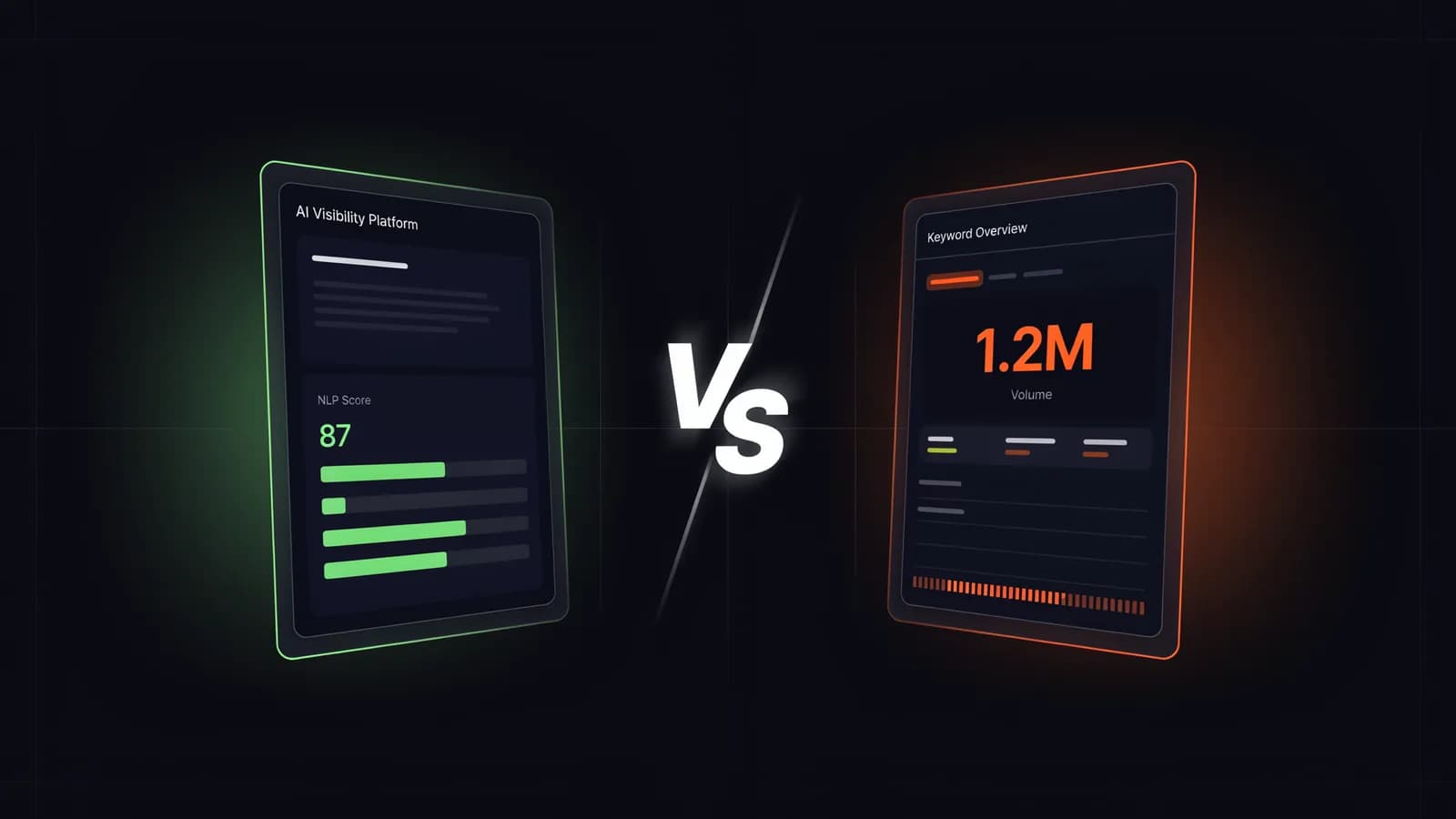
Surfer SEO rebranded to an AI Visibility Platform. Adobe acquired Semrush for $1.9B. Both tools changed — and most comparisons you'll find were written before either of these happened. If you're currently using Surfer or Semrush, or deciding between them, the question isn't which tool is better in the abstract. It's whether either tool still fits the way your team actually works. Have you looked at what you're paying and what you're actually using? Because the honest answer in 2026 isn't as clean as it used to be.
What Changed: Surfer 3.0 and Semrush's Adobe Acquisition
Surfer's rebrand isn't cosmetic. Surfer 3.0 — launched alongside the "AI Visibility Platform" positioning in June 2026 — shifted the product's core narrative away from content optimization scores and toward AI search presence. The Content Editor is still there, but the strategic framing now centers on making your content visible in ChatGPT, Perplexity, and Google's AI Overviews, not just traditional SERPs. That's a meaningful signal about where Surfer sees the market going.
The Semrush situation is more complex. Adobe's $1.9B acquisition closed on April 28, 2026. Adobe hasn't announced major product changes yet, but acquisitions of this scale rarely leave tools untouched. Enterprise features, deeper integration with Adobe's Creative Cloud and Experience Platform, and potential pricing restructuring are all on the table. Semrush has already launched a new "Semrush One" tier at $199/month — positioned between the Pro and Guru plans — which suggests pricing experimentation is already underway.
For your decision today: Surfer is doubling down on AI content optimization. Semrush is entering an integration and restructuring phase that may benefit enterprise users more than individual marketers or lean teams.
Surfer SEO (3.0) vs Semrush — Feature-by-Feature Comparison
Feature | Surfer SEO 3.0 | Semrush | Allable |
|---|---|---|---|
Content Editor / NLP scoring | ✅ Core feature | ✅ SEO Writing Assistant | ✅ AI-powered, integrated |
Keyword research | ⚠️ Limited (via Keyword Surfer) | ✅ Full database (27B+ keywords) | ✅ Full database, city-level data |
Backlink analysis | ❌ Not included | ✅ Comprehensive | ✅ Included |
Site audit | ⚠️ Basic | ✅ Full technical audit | ✅ Full technical audit |
SERP analysis | ⚠️ Content-focused | ✅ Deep SERP data | ✅ Real-time SERP data |
AI search / AEO features | ✅ New in 3.0 (AI Tracker) | ⚠️ Growing, not core | ✅ AI visibility built-in |
Competitor research | ❌ Minimal | ✅ Full suite | ✅ Full suite |
Rank tracking | ✅ Included | ✅ Included | ✅ Included |
PPC / Ads data | ❌ | ✅ Google Ads data | ✅ PPC campaign tools |
Local SEO | ❌ | ✅ Listing management | ✅ Local SEO module |
Social media tools | ❌ | ✅ Social tracker | ✅ Social module |
Starting price | $99/month (Essential) | $139.95/month (Pro) | $33/month (Pro) |
Pricing: Surfer 3.0 vs Semrush in 2026
Surfer's pricing changed with the 3.0 rebrand. The current plans:
- Essential: $99/month — 30 articles, Content Editor, basic AI features
- Scale: $219/month — 100 articles, full AI writing, team seats
- AI Tracker add-on: +$95/month — the core of the "AI Visibility Platform" claim
To get the full Surfer 3.0 experience — Content Editor at scale plus AI Tracker — you're looking at $314/month. That's not a lean-team budget. It's a content agency or enterprise budget.
Semrush pricing in 2026:
- Pro: $139.95/month — 5 projects, 500 keywords tracked
- Guru: $249.95/month — 15 projects, content marketing toolkit
- Semrush One (new): $199/month — positioned as a mid-tier option post-acquisition
- Business: $499.95/month — API access, extended limits
At the Guru level ($249.95/month), you get content marketing features that partially overlap with Surfer — but not enough to replace it for high-volume content workflows. Teams that need both tools regularly end up at $400–$500+/month.
Content Optimization: Where Surfer Still Has the Edge
Surfer's Content Editor is what built its reputation. You drop in a keyword, Surfer analyzes top-ranking pages for that query, and generates a content brief with NLP-based term recommendations, heading suggestions, word count targets, and a real-time content score as you write. The workflow is genuinely useful — especially for content teams that write high volumes of SEO articles and need a repeatable brief-to-draft process.
Surfer 3.0 adds AI writing directly into the Content Editor (previously a separate workflow). The AI drafts now use your content score as a live guide — so the output is more likely to hit Surfer's optimization targets than a generic AI draft. The integration is tighter than it was in 2.0, and for teams that were already Surfer users, it removes a step from the workflow.
What 3.0 adds beyond content: the AI Tracker monitors your content's presence in AI-generated answers (ChatGPT, Perplexity, AI Overviews). This is a genuinely new capability — not just a renamed feature — and it's the most meaningful differentiation from Semrush in the current market. Semrush has added some AI overview tracking, but it's not the core product focus the way it is for Surfer.
The trade-off: AI Tracker costs $95/month on top of your base plan. If you're paying $99/month for Essential and $95 for AI Tracker, you're at $194/month — and you still don't have keyword research depth, backlink analysis, or technical audit coverage. You're paying for a specialized writing-plus-AEO tool, not a full SEO platform.
Allable's approach: the content scoring and AI visibility features are part of the core platform, not sold separately. The distinction matters less for power users and more for teams that want predictable pricing without tracking which add-ons they actually use each month.
Content at Scale: Does Semrush's SEO Writing Assistant Hold Up?
Semrush's content workflow is less linear than Surfer's. The SEO Writing Assistant (SWA) connects to Google Docs or a built-in editor and checks your content for readability, target keywords, and originality — but the brief-generation and NLP scoring aren't as deep as Surfer's Content Editor. For teams that already know what they want to write and need a sanity check, the SWA is sufficient. For teams that need a repeatable brief-to-optimized-draft pipeline, Surfer is still the stronger choice.
ContentShake AI (Semrush's AI-assisted content tool) narrows the gap. It generates briefs, drafts content, and integrates with the SWA workflow — but it's an add-on, not included in base plans. ContentShake adds $60/month on top of your Semrush subscription, which means Semrush's content workflow starts to overlap with Surfer's on price without fully matching it on depth.
Where Semrush pulls ahead on content: the Topic Research tool and Keyword Magic Tool give you a much better starting point for deciding what to write. Surfer tells you how to write it. Semrush tells you what to write — based on actual keyword data, search volume trends, and competitor gap analysis. The ideal workflow has always been "Semrush for ideation, Surfer for execution," which is why so many teams ended up buying both.
Allable integrates both layers: keyword research and content optimization in one interface, with AI drafting that pulls from keyword context rather than manual optimization. The workflow is less specialized than Surfer's Content Editor — it won't win on pure NLP scoring depth for teams that need that — but it removes the "two subscriptions for one workflow" problem that's been a consistent friction point for lean teams.
SEO Research & Keyword Tools: Where Semrush Still Dominates
This is not close. Semrush's keyword database — 27+ billion keywords, competitive gap analysis, keyword difficulty modeling, and PPC data — is one of the most comprehensive available. If your work involves deep keyword research, competitor intelligence, technical audits, or backlink prospecting, Semrush is the more powerful tool.
Surfer's keyword research via Keyword Surfer (the Chrome extension) is useful for quick lookups but not a replacement for a full keyword database. The core Content Editor workflow is focused on optimizing content you've already decided to create — not discovering what to create in the first place. Surfer 3.0 hasn't fundamentally changed this gap.
Allable's keyword database is built on city-level granularity data and covers the full research-to-optimization workflow in one interface. You don't need a separate subscription for research and a separate one for content scoring. That's the core pitch for lean teams: fewer tools, less context switching, lower monthly spend.
Who Should Use Surfer 3.0, Who Should Use Semrush — And Who Needs Neither
Use Surfer SEO 3.0 if:
- Your primary workflow is high-volume content production (10+ articles/month)
- You have a dedicated content team that lives inside the Content Editor
- You're actively building for AI search visibility (Perplexity, ChatGPT citations, AI Overviews)
- You already have a separate SEO research tool and don't need Surfer to cover that
- Budget: $99–$314/month depending on AI Tracker needs
Use Semrush if:
- You need a comprehensive SEO platform covering research, audit, backlinks, and tracking
- You manage multiple clients or properties (5+ projects minimum)
- Technical SEO, competitor intelligence, and PPC research are part of your workflow
- You're in an enterprise environment where Adobe integration may become relevant post-acquisition
- Budget: $139.95–$499.95/month
Use neither (or reconsider the stack) if:
- You're a lean marketing team (1–3 people) managing one or two domains
- Your content volume is under 8 articles/month
- You're currently paying for both tools and using 30% of each
- You want keyword research, content optimization, AI visibility, and rank tracking in one tool under $100/month
Quick Verdict
Use case | Best tool |
|---|---|
High-volume content at scale (10+ articles/month) | Surfer SEO 3.0 (Scale plan) |
Full SEO research + technical audit + backlinks | Semrush (Guru or higher) |
AI search visibility (AEO, generative engine optimization) | Surfer 3.0 + AI Tracker |
Lean team needing research + content + rank tracking | Allable (Pro plan) |
Enterprise with Adobe ecosystem integration | Semrush (post-acquisition roadmap) |
Conclusion
The Surfer SEO vs Semrush comparison in 2026 is genuinely harder to call than it was a year ago — not because both tools got better, but because both are in transition. Surfer is repositioning as an AI visibility platform while keeping its content optimization roots. Semrush is absorbing the implications of a $1.9B enterprise acquisition while launching new pricing tiers.
If you're a content-heavy team that lives inside a writing tool and wants AI search coverage, Surfer 3.0 at Scale makes sense. If you need the full SEO research and technical stack and work across multiple clients or properties, Semrush — despite the price — remains the most complete option.
But if your team is smaller, your budget is tighter, and you're tired of paying for overlap between two expensive tools, that's exactly the gap Allable was built to fill. One platform, every workflow, at a fraction of the combined cost.