
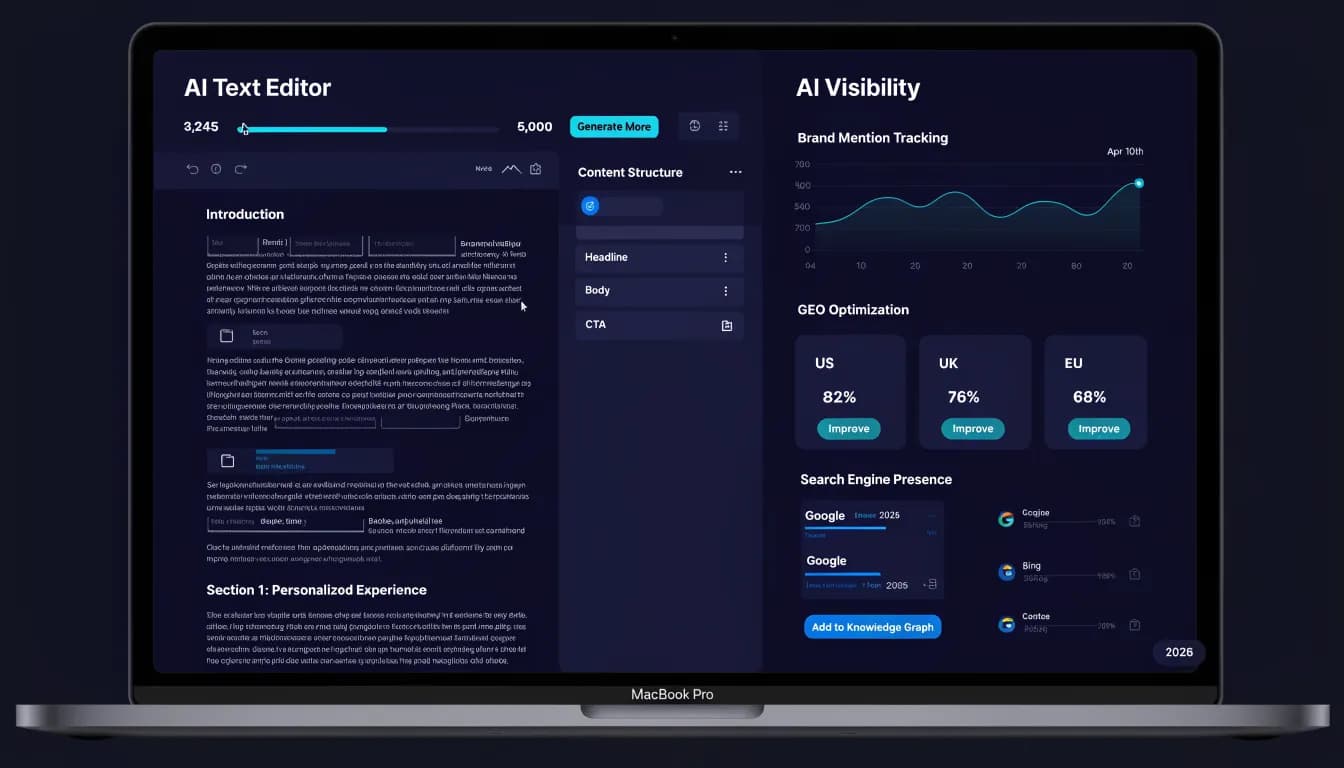
You open Writesonic to write a blog post — and the first thing you see isn't a blank editor. It's an AI visibility dashboard. The tool you paid for to generate content has quietly become something else. Three weeks of testing across 5 real marketing tasks revealed what the homepage doesn't tell you.
What Is Writesonic in 2026? (It's Changed)
Writesonic launched in 2021 as an AI copywriting tool — one of the early wave of GPT-3-powered platforms that promised to help marketers write faster. It worked, more or less. The templates were useful, the output was serviceable, and it competed directly with tools like Jasper and Copy.ai on word count, template variety, and pricing.
Then came the pivot.
In 2024 and into 2025, Writesonic repositioned itself around a concept the SEO world started calling GEO — Generative Engine Optimization. The idea: as ChatGPT, Perplexity, and Google's AI Overviews eat into traditional organic search traffic, the question isn't just "does this rank on Google?" but "does this get cited by AI?"
Writesonic bet the company on being the answer to that question.
Today, the platform is built around four main components:
- AIO Writer — their AI article writing tool, redesigned with "AI visibility" baked into the output. It generates long-form content with the explicit goal of being cited in AI-generated answers, not just ranked in traditional search.
- Chatsonic — their AI chat interface, similar to ChatGPT but with web access and brand voice controls. It's the day-to-day workhorse for most users.
- Botsonic — an AI chatbot builder for embedding AI chat on your website or product, trained on your own data.
- AI Visibility Dashboard — the newest and most prominent feature, which audits your existing content against AI citation patterns and scores how "AI-visible" your brand is.
The writing templates are still there. Over 100 of them, covering social copy, product descriptions, ad headlines, email subject lines. But they're no longer the main event. They feel like the legacy layer underneath a product that has moved on.
That shift matters because the use case has changed. If you came to Writesonic for fast, template-driven content output — you'll find it, but it's not what the product is optimizing for anymore. If you're trying to understand whether Writesonic is worth your subscription in 2026, you need to evaluate it as an AI visibility platform with writing features, not the other way around.
Writesonic Pricing 2026
Writesonic's pricing has been restructured to align with the new positioning. Here's what you're actually paying for at each tier.
Free Plan
The free plan gives you 25 AI article generations per month, access to Chatsonic, the basic template library, and limited access to the AI Visibility Dashboard. It's genuinely useful for evaluating whether the product fits your workflow, but 25 generations runs out faster than you'd expect if you're testing the AIO Writer seriously. No brand voice, no team features.
Individual Plan — $16/month (billed annually) or $20/month
This is the plan most solo marketers or content creators land on. You get unlimited AI writing (within fair use), access to all 100+ templates, Chatsonic with web access, one brand voice profile, SEO mode, and full access to the AI Visibility Dashboard.
At $16/month annually, this is one of the more competitive price points in the AI writing space. For a solo creator or small business owner who wants to experiment with AI visibility features without enterprise pricing, this makes sense as a trial commitment.
The ceiling you hit here: one brand voice, no collaboration features, limited API access. If you work with a team or manage multiple clients, you'll feel that wall quickly.
Teams Plan — $79/month (billed annually)
The Teams plan unlocks up to 5 user seats, multiple brand voice profiles, team collaboration inside documents, advanced AI visibility reporting, and priority support. This is where Writesonic starts functioning as an agency or team tool.
$79/month for 5 seats works out to roughly $15.80 per user — which is competitive if all five seats are actively used. The problem is that "AI visibility reporting" at this tier is still fairly surface-level. It tells you where your content is underperforming in AI citations; it doesn't automatically fix it or give you a clear next-step workflow.
Enterprise — Custom Pricing
Enterprise gets you custom AI model training, a dedicated account manager, SSO, advanced API access, and custom workflows. Pricing is negotiated based on team size and usage. If you're a larger content operation and the AI visibility angle is core to your strategy, this is the conversation to have.
Writesonic Tested on 5 Real Marketing Tasks
I spent three weeks running Writesonic through actual marketing work — not benchmark prompts, not demo content, but the kind of tasks that show up in a real content calendar.
Task 1: Writing a 2,000-Word SEO Blog Post With the AIO Writer
The AIO Writer is Writesonic's flagship for long-form content in 2026. You enter a topic, choose a target keyword, set your brand voice, and the tool generates a structured outline before producing the full article.
The output quality is noticeably better than Writesonic's previous article generator. The structure is logical, the headings are reasonably SEO-informed, and the AI pulls in current information via web access if you enable it. For a 2,000-word post on a competitive marketing topic, the first draft needed about 30–40% rewriting to reach publishable quality — mostly to add specificity, remove hedged language, and inject a real perspective.
The "AI visibility optimization" layer is baked in as a checklist the tool runs after generating content: it flags phrases more likely to be cited by AI systems, suggests answer-forward paragraph structures, and scores the draft's "AI visibility readiness." This is genuinely interesting in concept. In practice, the scoring felt opaque — it's not always clear why a section scores lower or what specific edit would move the needle.
For a team producing volume content with human editors downstream, the AIO Writer is a credible first-draft machine. For a solo creator who needs content publishable with minimal editing, you'll spend significant time on every piece.

Task 2: Generating Ad Copy Variants (Google + Meta)
Writesonic has a dedicated ad copy workflow covering Google search ads, Meta feed ads, and display creative. The process: enter your product, target audience, key benefit, and USP — the tool returns 5–8 variants per format in under a minute.
Google search ad headlines: strong. The tool understands character limits (30 and 90 characters for headlines and descriptions respectively), and most outputs were usable without structural changes. Over a 20-ad test, I needed heavy revision on roughly 3 out of 10 — mostly where the AI tried to cram too many claims into a single headline.
Meta ad copy (primary text + headline): more variable. The benefit-forward variants performed better than the story-led attempts. The AIDA template produced punchy, conversion-oriented copy with minimal editing required. Where it fell apart was emotional resonance — the copy technically described the product but didn't create the urgency that converts at scale.
Compared to Jasper on the same briefs, Writesonic's ad output was comparable on structure and slightly weaker on natural language variety. At $16/month versus Jasper's $49/month, that gap isn't enough to disqualify Writesonic for teams that don't need agency-grade ad precision.
Task 3: Tracking Brand Mentions in ChatGPT (AI Visibility Module)
This is where Writesonic is genuinely building something that most writing tools haven't touched. The AI visibility module lets you enter a brand name or topic and check how it appears (or doesn't appear) in AI-generated answers from ChatGPT and other LLMs.
The experience: you enter a query like "best AI writing tools for marketing teams," and Writesonic shows you whether your brand appears in the AI's response, what position it holds, and how the surrounding context frames it. It also tracks this over time, so you can see whether content updates or new articles shift your AI citation profile.
The limitations are real. The monitoring is not live — it samples responses at intervals rather than continuously. The coverage is limited to a handful of LLM configurations, not the full range of AI search surfaces your audience actually uses. And the "recommended fixes" it surfaces to improve your citation rate are high-level rather than specific (think: "add more factual claims" rather than "edit this specific paragraph").
That said, no other writing tool in this price range offers anything comparable. If AI visibility is part of your 2026 content strategy — and for most content teams it should be — this is a meaningful differentiator over tools that haven't added this dimension at all. For a more complete picture of what AI visibility tools can do, the best AI visibility tools comparison covers options built specifically around this use case.

Task 4: GEO Optimization — Adapting Content for AI Overviews
GEO (Generative Engine Optimization) is the practice of structuring content so it gets cited in AI-generated answers rather than just ranked in traditional search. Writesonic has built a dedicated GEO workflow around this.
The process: paste in an existing piece of content, specify the target query or topic, and Writesonic analyzes the content against what it calls "AI citation patterns." It then suggests structural edits — reorganizing paragraphs to lead with direct answers, adding definition statements, restructuring lists for AI scannability, and flagging sections where the content is too conversational to be reliably cited.
I ran five existing articles through this workflow. The structural recommendations were sound — every major suggestion aligned with what the SEO and GEO literature recommends for AI Overview eligibility. The AI correctly identified that my more conversational posts (narrative-heavy, fewer direct answer statements) were the weakest candidates for AI citation.
What the tool can't do: verify whether your content is actually appearing in AI Overviews after you make the changes. There's no closed-loop measurement here. The GEO optimization is advisory, not diagnostic. You'd still need to manually check AI search results — or use a dedicated monitoring tool — to confirm impact.
For content teams that haven't started thinking about GEO at all, this workflow is a practical starting point. For teams that need measurement alongside optimization, it's one piece of a larger toolkit.
Task 5: Creating a Social Media Content Calendar
Writesonic's social media tools have expanded beyond one-off post generation into a content calendar workflow. You define your brand voice, select platforms (LinkedIn, Instagram, Twitter/X, Facebook), set a posting cadence, and the tool generates a month's worth of post concepts — hooks, formats, and draft copy — mapped to a calendar.
The output at a conceptual level is solid: the calendar structure is logical, the post types are varied (thought leadership, product-led, engagement bait, repurposed content), and the platform-specific formatting is mostly appropriate.
Execution quality is where it gets inconsistent. LinkedIn posts hit consistently — professional tone, limited engagement bait, real substance. Instagram captions were the weakest output: even with brand voice enabled, they felt averaged across too many styles rather than specific to a voice. Twitter/X threads were unpredictable — some had real logical flow, others broke apart into disconnected points.
If you're a solo creator or small team who needs a starting structure for social planning rather than publishable-on-arrival content, the calendar workflow saves meaningful time. If you're an agency managing brand accounts where voice consistency is non-negotiable, plan for significant editing overhead on the social outputs specifically.
Writesonic Pros and Cons in 2026
Pros:
- The AIO Writer produces structurally sound long-form content with genuine AI visibility awareness built in — no other mainstream writing tool has this at the individual tier price point
- 100+ templates covering most commercial copy scenarios, with e-commerce and product description templates being particularly strong
- Chatsonic (their chat interface) handles research, drafting, and ideation tasks competently, with real-time web access
- The AI Visibility Dashboard gives content teams a fast audit mechanism for existing libraries — identifying GEO-readiness gaps at scale
- Competitive pricing: $16/month for the Individual plan is hard to argue against for a solo user who wants to test AI visibility features seriously
- The brand voice feature at Individual tier is genuinely functional — it learns your tone across multiple documents without constant re-training
Cons:
- The pivot to AI visibility is real, and the writing templates feel de-prioritized as a result. If templates are your primary use case, tools that focus exclusively there will perform better
- Output quality on first drafts still requires 30–40% rewrite effort for publishable content — that's comparable to the market, not better than it
- The AI Visibility Score is a model, not a measurement. You can't verify actual AI citation performance from within the platform
- Social copy output is inconsistent by platform — particularly weak on Instagram and Twitter/X threads
- The Teams plan at $79/month is expensive if you're not using all 5 seats or if the AI visibility reporting doesn't drive a measurable workflow change
- Documentation and onboarding for the new AI visibility features is underdeveloped — the learning curve is steeper than the marketing suggests
Who Is Writesonic Best For in 2026?
Content marketers who want to future-proof against AI search. If your team is actively thinking about how your content performs in ChatGPT, Perplexity, and Google's AI Overviews, Writesonic is one of the few tools that attempts to operationalize this. The AI Visibility Dashboard is imperfect, but it's further along than anything most of your competitors are using.
Solo creators and freelancers at the $16/month tier. At that price, you get a capable content drafting tool plus the AI visibility auditing as a bonus. It's a defensible subscription if you're managing a blog or content calendar and want AI assistance without Jasper's price tag.
E-commerce teams with high-volume product copy needs. The product description templates are one of Writesonic's most consistently strong outputs. If you're running a catalog with hundreds of SKUs, the output-to-editing-effort ratio is favorable.
Who should look elsewhere:
- Agencies managing 10+ clients who need robust multi-brand controls and reporting — the Teams plan doesn't scale well
- Creators who need publishable first drafts with minimal editing — the rewrite burden is too high
- Teams whose primary need is social copy — too inconsistent across platforms
- Anyone who needs verified AI citation monitoring — Writesonic doesn't offer this yet
Writesonic Alternatives Worth Considering
If Writesonic's AI visibility pivot doesn't match what you actually need, here's how the alternatives stack up for different use cases. For a full side-by-side breakdown of what's available, the Writesonic alternatives guide covers eight options with direct feature comparisons.
Jasper remains the strongest option for brand-consistent content at scale. Jasper's brand voice features are more sophisticated than Writesonic's, and the long-form output quality is marginally stronger on direct comparison. The trade-off: Jasper costs significantly more — the Creator plan starts at $49/month — and it has no equivalent to Writesonic's AI visibility tooling. If writing quality and brand consistency matter more to you than AI visibility features, Jasper is worth the premium.
Copy.ai has moved heavily toward automated marketing workflows rather than manual writing assistance. If you need AI-assisted campaign sequences, automated lead nurture copy, or multi-step GTM workflows, Copy.ai's current product is more suited to that than Writesonic. For pure writing quality on individual pieces, Writesonic and Copy.ai are comparable.
Surfer SEO is the right choice if traditional SEO optimization is your primary goal and you're less interested in GEO/AI visibility. Surfer's content editor with real-time keyword optimization produces well-structured, rank-optimized content. The AI writing component is secondary to the optimization layer — the opposite of what Writesonic is building toward.
Allable.ai takes a different approach entirely: instead of being a specialized writing tool, it combines SEO research, content strategy, competitor monitoring, AI writing, and campaign management in one platform. If you're finding yourself stitching together Writesonic for drafting, Semrush for keyword research, and another tool for competitor tracking, Allable consolidates that workflow. It's available at Free forever, Pro at €31/month, or Business at €91/month — and unlike Writesonic, the SEO data and content tools are built into the same environment rather than layered on top of a writing product.
Frequently Asked Questions
- Is Writesonic still good for AI content writing in 2026?
- Yes, but with a significant caveat. Writesonic produces competent long-form drafts and has a comprehensive template library. The output requires 30–40% editing to reach publishable quality, which is in line with the AI writing market generally. Where Writesonic has genuinely differentiated in 2026 is in the AI visibility tooling — the GEO-focused features that most pure writing tools don't offer. If you're evaluating it purely as a writing tool, it's solid but not leading the field. If you need the combination of writing output and AI visibility optimization, it's one of the few options that bundle both.
- Has Writesonic's pricing changed after the AI visibility pivot?
- Writesonic restructured its pricing alongside the platform pivot. The current Individual plan at $16/month (billed annually) is more affordable than the pre-pivot plans for equivalent feature access. The Teams plan at $79/month is where the new AI visibility reporting becomes available at a team level. The free plan still exists with 25 generations per month, which is genuinely usable for evaluation. If you were on an older plan, you likely received a migration offer — check your account settings for any legacy tier that may still apply.
- What is Writesonic's AIO Writer and how is it different from the old article generator?
- AIO stands for AI-Optimized (sometimes also AI Overview Optimized in Writesonic's documentation). The AIO Writer generates long-form content with a focus on being cited in AI-generated answers — specifically targeting the paragraph structures, factual density, and answer-forward formatting that AI systems like ChatGPT and Perplexity tend to pull from. The old article generator produced content optimized primarily for traditional keyword-based SEO. The AIO Writer is not dramatically different in output quality, but the optimization layer and the post-generation visibility scoring make it a meaningfully different workflow tool for teams focused on generative search performance.
- How does Writesonic compare to Jasper in 2026?
- Jasper has stronger brand voice consistency and marginally better long-form output quality on direct comparison, but costs significantly more — starting at $49/month versus Writesonic's $16/month Individual plan. Writesonic's AI visibility tooling has no equivalent in Jasper's current product. For teams where brand voice accuracy is paramount and AI visibility is secondary, Jasper is worth the premium. For teams experimenting with GEO and generative search optimization at a lower price point, Writesonic is the better entry point.
- Can Writesonic replace Semrush or a dedicated SEO tool?
- No. The AI Visibility Dashboard audits content for GEO-readiness but does not perform the keyword research, backlink analysis, technical SEO auditing, or rank tracking that dedicated SEO platforms provide. Writesonic and Semrush serve different functions and are used by most serious content teams in parallel. If you're looking for a platform that combines AI writing with actual SEO data in one environment — keyword research, SERP analysis, competitor monitoring, and content creation — you'll need to look at more integrated marketing platforms rather than writing tools.
See How Allable Handles AI Writing and SEO Together
Allable combines keyword research, AI content drafting, competitor monitoring, and campaign management in one platform — no stitching required.